
mINT: The First Mechanistic Interpretability Framework for World Models
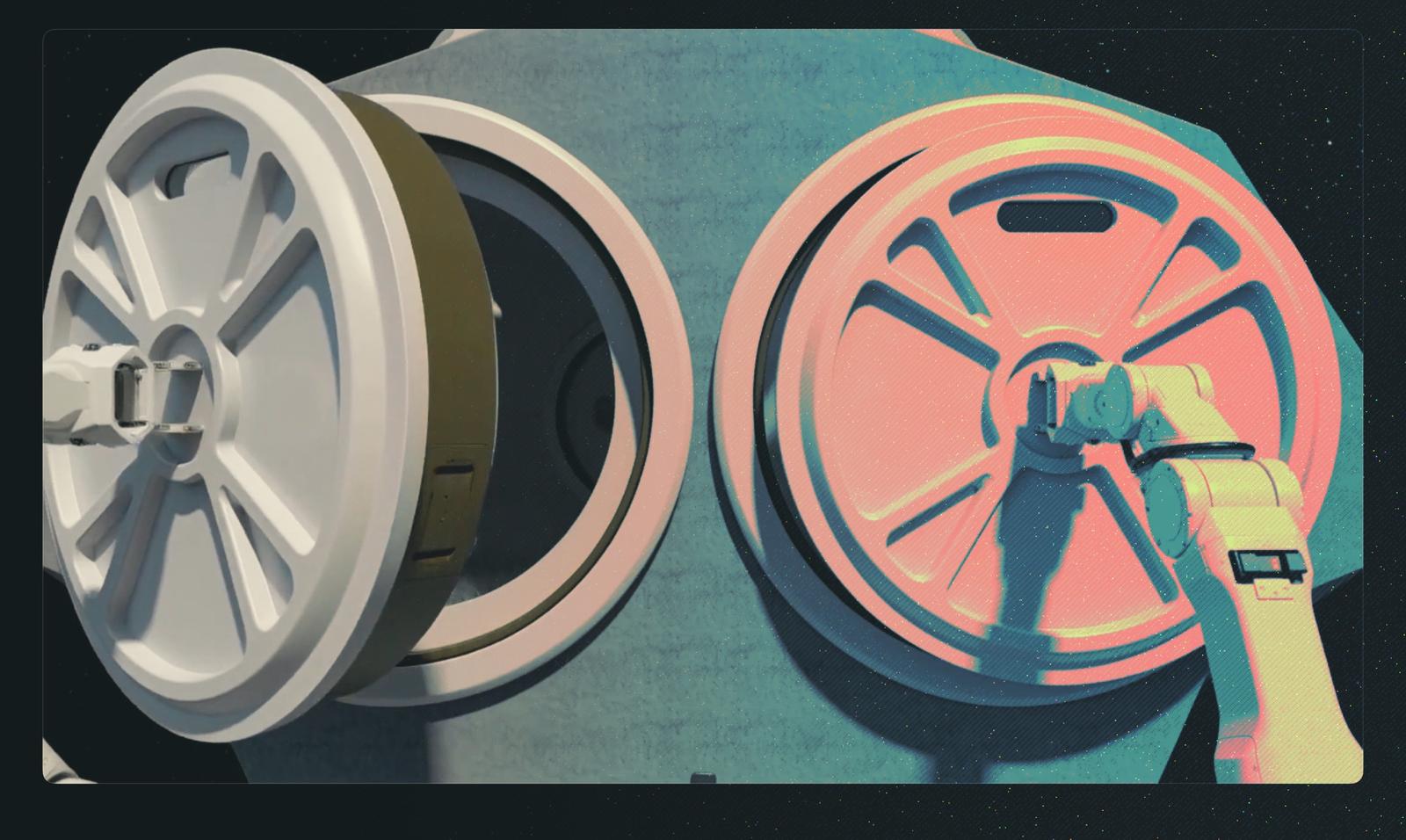
TL;DR: Hedra’s mINT (mechanistic interpretability) framework uses an understanding of world-model internals to guide inference-time steering. By locating the layers and attention heads that drive a specific behavior, we improve frozen MiniMax H3’s strict success rate on multi-machine instructions from 39/256 (15.2%) to 199/256 (77.7%), without updating model weights.
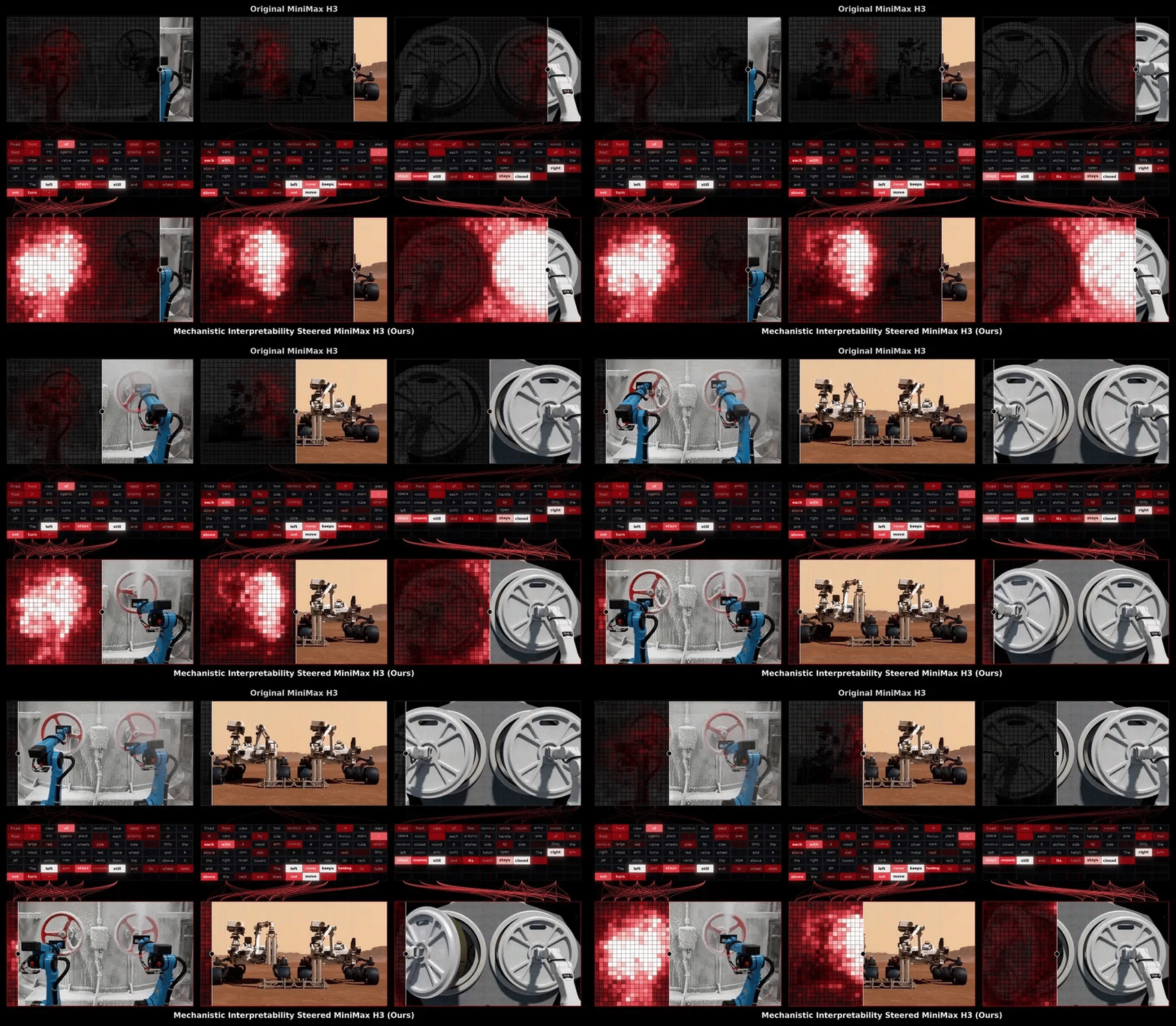
World models predict how a physical scene changes over time. In Physical AI, teams use world models to simulate robot actions, multi-object interactions and physical outcomes. Yet precise instructions still break down: ask one robot arm to turn a valve while an identical arm stays still, and both may move. The standard fix is post-training across the full model. Online reinforcement learning (RL) works, but a single capability can take hundreds to over a thousand GPU-hours. Before committing to that training, we should identify the internal mechanisms that control the behavior.
Hedra’s mINT framework turns that understanding into control over world models. Mechanistic interpretability identifies which internal layers and attention heads drive a behavior. Our framework locates those components, tests their causal role and uses them to change the model’s output. This gives us training-free interventions at inference time. We’re making this process reusable for AI research agents, so mechanistic understanding can guide the next experiment.
MiniMax H3 moves machines it was instructed to keep still
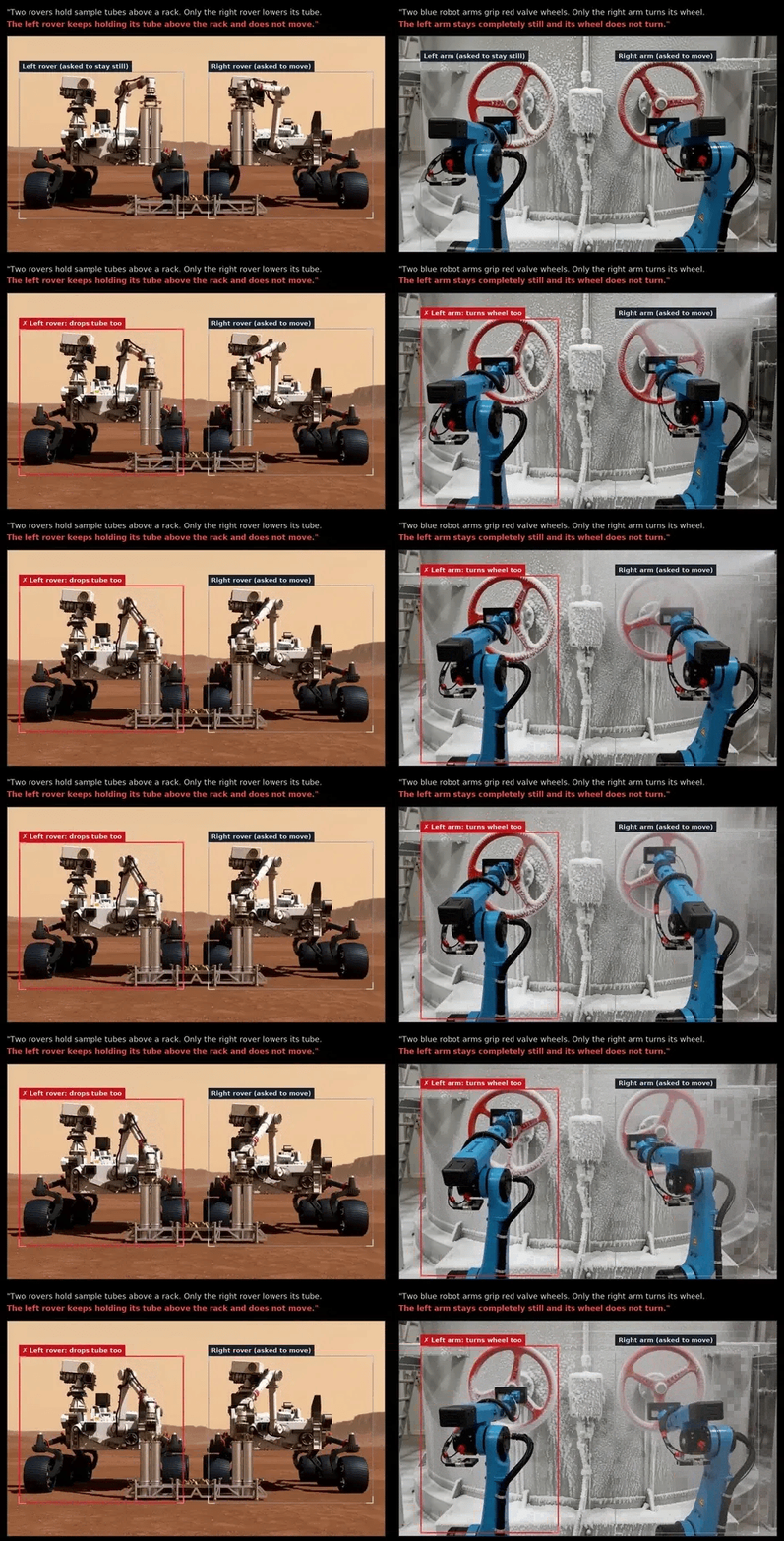
We test the framework on MiniMax H3's ability to control identical machines independently. Across 256 clips in which only one machine was instructed to act, the base model succeeded in 39 cases (15.2%). The failures in Figure 2 show the non-target machine moving despite the stay-still instruction.
Success requires the target machine to complete its action while the others remain still.
The mINT framework starts with a behavior we can score. We search for internal components that change that behavior when we intervene on them, then use control experiments to test their causal contribution. Those findings guide how we steer the frozen model, with the correction evaluated against the original success criterion. A reusable agent skill packages the localization and steering procedure.
From 2,800 attention heads to three
H3 generates video through repeated denoising steps. Each step passes activations through 50 transformer blocks with 56 attention heads each, for 2,800 heads in total. We begin with contiguous groups of blocks, then examine individual heads within the responsive group.
Early denoising steps establish coarse spatial structure and motion trajectories; later steps refine visual detail. We therefore restrict the search to the first two denoising steps, when an intervention can change the scene's emerging motion.
The stay-still intervention isolates blocks 35 to 39
We first increase video-to-text attention on the prompt's stay-still clause. If a group of blocks contributes to suppressing motion in the non-target machines, amplifying that clause should change the generated trajectory.
Let be the tokens in the stay-still clause, identified in each prompt by a vision-language model (VLM), as shown in Figure 2. Let be the attention mass that future-frame video token assigns to them. Adding a positive bias to those tokens' pre-softmax attention logits changes the head output as follows:
Here, is the original head output, and is the value vector of token . Heads that assign almost no attention to that clause change little; heads that already attend to it receive a stronger intervention.
For each decoded clip, we measure frame-to-frame pixel changes within the machines' bounding boxes. We check whether the non-target machine falls below the stillness threshold while the target completes its action.
With denoising steps and , scanning contiguous five-block groups across all 50 blocks identifies blocks 35 to 39 as the only responsive band. Adjacent blocks, including 30 to 34, do not suppress the unwanted motion. Intervening on each of blocks 35 to 39 separately resolves only some failures, suggesting that multiple heads in the band contribute together.
Subset probing identifies contributions that single-head tests miss
An individual head can help suppress motion without pushing the non-target machine below the stillness threshold on its own. Single-head tests can therefore miss heads that contribute when combined with others. We activate a random half of the 280 candidate heads in each trial. This lets us estimate marginal contributions across all candidate heads in parallel, testing each head with different partners without exhaustively evaluating every combination.
Evaluating random subsets does not require finishing the remaining denoising steps or running the 3D VAE video decoder. We stop each probe run after the second denoising step and score its predicted clean video latent. Under the flow-matching convention used here, the velocity prediction gives the estimate . We compare H3’s predicted clean latent for future frames with H3’s conditioning-frame latent inside the non-target machine's bounding box:
Here, is the conditioning-frame latent, indexes future latent frames and covers the non-target machine. Lower drift indicates less unwanted motion. On 112 full validation videos, the early-latent ranking agreed 99% of the time with whether the non-target machine moved in the final decoded video. Using this proxy accelerated subset evaluation by more than 3×: stopping after the first two steps avoids the remaining denoising steps and the 3D variational autoencoder (VAE) video decoder.
For each subset, we normalize mean drift between the all-candidate intervention and the base model. We then fit a linear model across the candidate heads, using each subset's head-inclusion indicators to predict normalized drift. Forward stepwise least squares accounts for the selected heads before testing whether another head explains the remaining variation. Scores and head-inclusion indicators are centered within each batch. We stop when no remaining head clears the 95th-percentile threshold across random permutations of the residual:
The candidate pool is , each sampled subset is , and is the set of heads selected by the fit. The indicator equals 1 when head is in subset . A normalized score of 0 corresponds to intervening on all candidate heads; 1 corresponds to the base model. A positive fitted coefficient means that activating head predicts lower drift after accounting for the other selected heads.
We test 108 random half-subsets across the 280 candidate heads and use 200 random permutations for the noise test. The linear fit selects three heads above the noise floor:
Attention head | Fitted coefficient, |
|---|---|
Block 37, head 2 | 0.32 |
Block 37, head 26 | 0.23 |
Block 38, head 48 | 0.14 |
Subsets that exclude all three heads remain close to the base model, with normalized drift of 0.88, even though they amplify roughly half the candidate pool. Subsets containing all three reach 0.16, recovering nearly the full candidate-pool effect.
The block intervention narrows 2,800 heads to 280 candidates, early-latent scoring skips the remaining denoising steps and video decoding, and randomized subsets and the linear fit identify contributions across head combinations. Together, they turn an internal-model analysis into a repeatable localization procedure.
Three heads steer MiniMax H3 without retraining
Inspecting the three heads reveals why H3 fails to keep the non-target machines still: it does not attend strongly enough to the text prompt. The identical machines begin in poses associated with action, and video-to-video self-attention favors motion across those visually similar objects. The heads associate relevant prompt words with the corresponding machines: in head 38.48, attention to the stay-still tokens is 10 times stronger on non-target machines than on the target. Yet video tokens allocate only 2.4% to 7.2% of their total attention mass to the prompt.
Our interpretation is that the stay-still signal is correctly grounded but too weak to overcome the visual motion pattern. This diagnosis motivates an adaptive intervention that increases prompt attention and scales the output of the three located heads.
The inference-time steering rule uses the prompt as a whole. Let contain all prompt tokens and be the prompt-attention share for video token in head . During the first two denoising steps, we set , then scale the head's output by . The rule preserves relative attention weights within the prompt and within the non-prompt tokens:
In this expression, is the attention-weighted value average within the prompt. The floor changes the balance between prompt and non-prompt contributions; controls how strongly the resulting head output is written into the residual stream.
Tokens whose prompt attention already meets the floor pass through the clamp unchanged before output scaling. Unlike the localization probe, the final rule does not need stay-still token lists, spatial masks or prompt parsing. The localization and evaluation stages still use the clause and bounding boxes described above.
We fit the intervention parameters on 64 calibration videos, obtaining for all three heads and for heads 37.2, 37.26 and 38.48. We then freeze those parameters for evaluation across 256 videos spanning 16 unseen machine types.
Evaluation criterion | Base MiniMax H3 | Steered MiniMax H3 |
|---|---|---|
Strict selective-motion success | 39/256 (15.2%) | 199/256 (77.7%) |
Success allowing slight non-target motion | 73/256 (28.5%) | 226/256 (88.3%) |
For MiniMax H3, strict selective-motion success rises from 15.2% to 77.7%, an increase of 62.5 percentage points. The weights remain frozen throughout. Head discovery and calibration identify the intervention; the inference-time rule applies it to new scenes.
Steering three heads outperforms prompt engineering in MiniMax H3
Chart data
| Prompt condition | Successful clips out of 64 |
|---|---|
| Original prompt | 17 |
| “remains motionless” | 22 |
| “keeps its position” | 29 |
| “never moves” | 21 |
| No stay-still clause | 8 |
| Resting state only | 18 |
| Stay-still twice | 17 |
| Extra emphasis | 25 |
| Extra held-object | 7 |
| Still before action | 7 |
| Prompt before scene | 6 |
| Three-head edit | 58 |
Chart data
| Attention-head condition | Successful clips out of 64 |
|---|---|
| No edit (base) | 17 |
| Layers 0 to 9 | 16 |
| Layers 10 to 19 | 16 |
| Layers 20 to 49 (1) | 29 |
| Layers 20 to 49 (2) | 18 |
| Layers 35 to 36, 39 to 40 | 19 |
| Layers 37 to 38 (1) | 18 |
| Layers 37 to 38 (2) | 7 |
| Layers 37 to 38 (3) | 21 |
| Top still-word heads | 19 |
| Top prompt heads | 14 |
| Heads 37.2, 37.26, 38.48 | 58 |
Chart data
| Layout condition | Base H3 | Steered H3 |
|---|---|---|
| Mirrored | 13 | 51 |
| Shifted | 21 | 54 |
| Scaled up | 10 | 56 |
| Scaled down | 42 | 58 |
| Smaller + shifted | 46 | 55 |
We run three sets of ablations on a 64-clip subset. For evaluation, we combine sampled keyframes, enlarged first/middle/last crops of stationary machines, pixel-difference maps and per-frame box-motion curves into a composite sheet for a model judge. Our evaluation used Opus 5.5 and matched human inspection on 64 of 64 checked clips.
Prompt changes. Across ten variations, including stronger stay-still wording and resting-state descriptions, none produces more than 29 successful clips out of 64. Moving instructions before the scene description reduces success to 6/64. With the original prompt, the three-head intervention improves success from 17/64 to 58/64.
Head controls. Applying the same steering parameters to ten alternative head triples, including heads with the highest raw prompt attention, produces 7 to 29 successful clips out of 64, compared with 58/64 for the selected heads. Blocking the selected heads from reading the prompt reduces success from 17/64 to 0/64; blocking random triples leaves it unchanged.
Position and scale. The intervention improves success across mirrored, shifted and rescaled layouts (Figure 4C). With the images held fixed and the instruction switched to the other machine, base H3 succeeded on 33 of 64 clips and steered H3 on 58.
The selected heads give us a causal control over this failure: strengthening their prompt signal improves selective motion, while blocking it eliminates successful clips in the ablation set. The highest-attention controls also show why an attention map alone is insufficient. We have to test which heads change the output. The position and scale tests show that the resulting intervention survives changes to the scene layout.
Autonomous research needs mechanistic diagnosis
To avoid repeating manual exploration for every new failure mode, we packaged the mINT framework’s localization and steering procedure into a mechanistic interpretability skill: an instruction document for coding agents, with no hardcoded layer or head IDs, paired with a preregistered search script.
For the selective-motion failure above, the automated pipeline ran from scratch without a handwritten word list. It independently localized blocks 35 to 39 and recovered the primary head found in our investigation. This run tested whether the localization procedure could be repeated automatically.
We separately tested whether the skill helps coding agents make appropriate research decisions. Seven design problems included choosing a localization approach for an ignored instruction versus unwanted subtitles, and identifying stable heads across subset batches. Across four agent models (Fable, Opus, Sonnet and Haiku), average success rose from 75.0% to 97.4% with the skill.
Chart data
| Agent model | Without skill | With skill |
|---|---|---|
| Fable | 82% | 100% |
| Opus | 72% | 100% |
| Sonnet | 85% | 97% |
| Haiku | 62% | 92% |
The skill captures how to choose an intervention suited to a failure, estimate head contributions across combinations and validate candidate heads against permutation and random-head controls. This gives coding agents a reusable procedure for investigating the next world-model failure.
Steering gravity and contact inside MiniMax H3
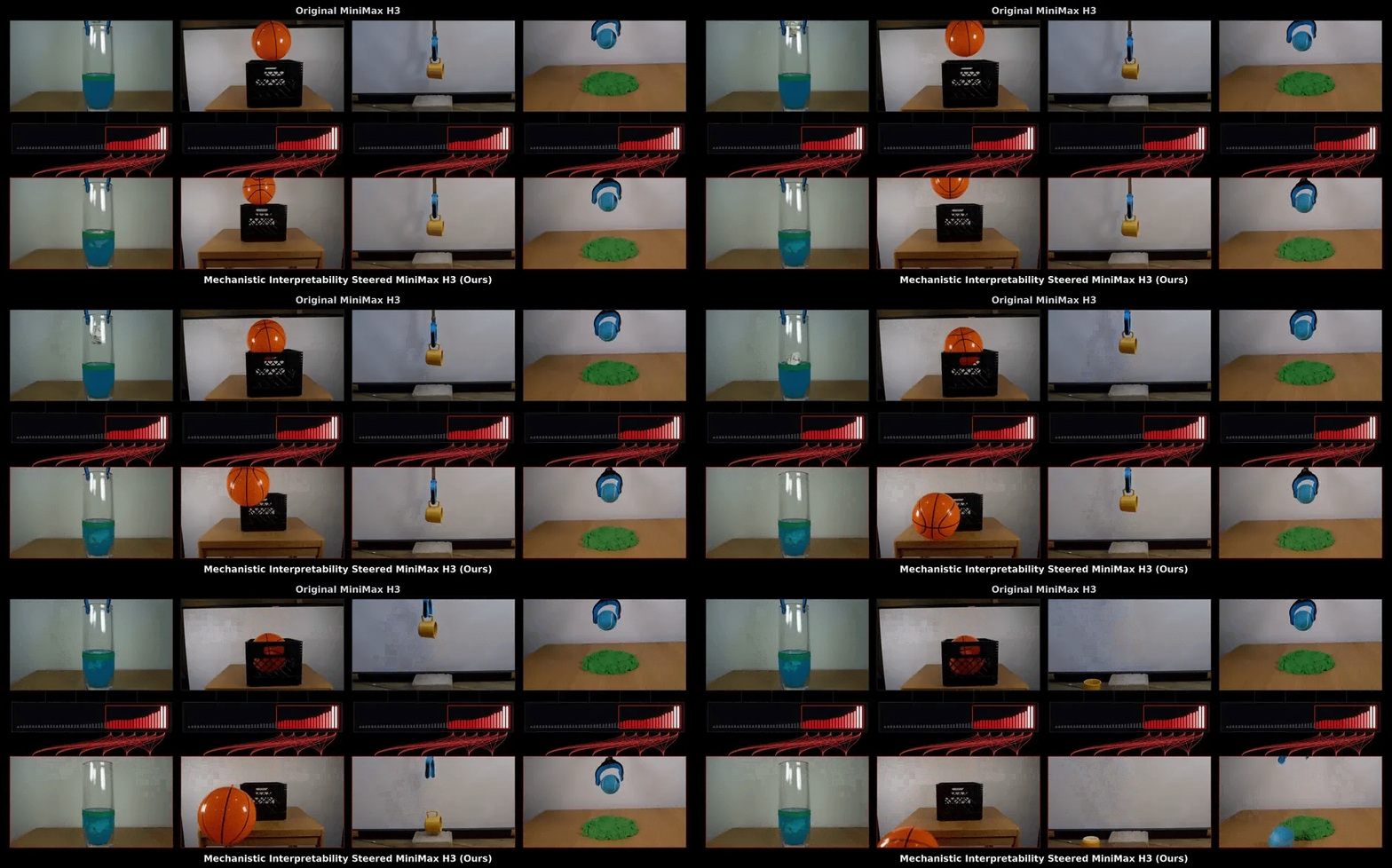
We also explored release-and-drop and collision scenes. The prompts specify normal gravity and rigid surfaces, but the base model can produce sluggish falls or incorrect contact.
We run frozen H3 on three reference scenes with contrasting environment outcomes and average the activation differences for each of the 50 blocks. This analysis isolates a physical-environment direction in blocks 30 to 49. At inference time, we apply this direction to blocks 30 to 49 without updating the model's weights. In the illustrated held-out scenes, the steered rollouts show a paper wad dropping into water, a basketball bouncing from a crate edge onto a table, a mug dropping onto a stone block, and a grabber-held blue ball dropping onto kinetic sand.
The intervention changes with the failure. Selective motion calls for strengthening three attention heads; these gravity and contact examples use an activation direction across a band of blocks. The common step is to locate an internal representation relevant to the failure and test whether changing it improves the rollout. This is how mechanistic analysis can guide a choice of intervention across different behaviors.
Mechanistic diagnosis should come before another training run
Our self-critiquing video systems research used internal signals in a verifier to identify candidate failures for human review. Here, we intervene inside the video generator itself and measure the change in its output.
At Hedra, we believe mechanistic diagnosis should come before another expensive training run. A failed output alone does not identify which internal components need to change. In selective motion, locating and steering three attention heads improved instruction following without updating model weights. The mINT framework gives us a concrete starting point for model improvement: an intervention we can test and refine.
Our ambition is for AI research agents to make these decisions through causal experiments: diagnose a failure, locate the internal components involved, test an intervention and carry what they learn into the next experiment.
Build with Hedra Model Factory
Hedra Model Factory brings together forward deployed researchers, agents, GPU compute and optimized inference to help solve your problem with a multimodal model. For teams developing world models, we work with you to define the behavior you need, investigate failures, run post-training and evaluate results. That work can extend through data preparation and deployment, with production data informing the next version.
Bring us the problem you need to solve. We help you build, run and keep improving a model you own.
Talk to our team about your model and the behavior you need to change.
References
MiniMax H3: An Open Model Breaking the Boundaries Between Tasks and Modalities.
Building self-critiquing video systems, Hedra. Related research on verification, separate from the generator interventions reported here.
DiffusionNFT: Online RL with Forward Process.
Flow-GRPO: Training Flow Matching Models via Online RL.
RewardDance: Reward Scaling in Visual Generation.
Interpreting Physics in Video World Models. Physical-variable probing and attention ablations in video encoders.
Causal Physics Steering in Video World Models via Concept Activation Vectors. Weight-frozen interventions that shift VideoMAE's physical-plausibility judgments.
The Invisible Hand of Physics: When Video Diffusion Models Know More Than They Show. Physical representations in video diffusion models examined through recovered latent trajectories.