Improve the system that improves the model.
We believe autonomous AI researchers will unlock the next generation of real-world AI applications.
Autonomous AI researchers must improve more than the model. They must improve the experiments, training methods, inference software and hardware execution that make the model useful. Hedra is building the research and infrastructure for this work.
Real-world problems demand new research.
Teams in robotics, manufacturing, biology and defense need models that understand their domains and meet their operating constraints. Working with images, video, physical measurements and simulation brings different training and evaluation demands from working with text.
Adapting a model to a specific domain takes more than a training run. Teams need to determine what data matters, how to evaluate progress and what the model must do in production. Answering these research questions requires infrastructure built for experimentation.

Research and infrastructure must advance together.
An AI researcher needs tools to understand a model and infrastructure to test model changes. We're developing interpretability tools that help researchers and agents examine model behavior, guide post-training and focus experiments on reducing training cost.
Our infrastructure must coordinate CPU and GPU compute for simulation engines, verifiable reinforcement learning environments, inference and training. World Model Runtime is our inference and orchestration engine. We're building it to let agents optimize models and their execution across heterogeneous hardware through changes to kernels, numerical precision and scheduling.
Agents tested our researchers' ideas for the Krea 3 image editing model on AMD Instinct MI355X GPUs. We tuned numerical precision, built custom kernels and reworked GPU communication, checking performance alongside quality and correctness. Each improvement exposed the next bottleneck.
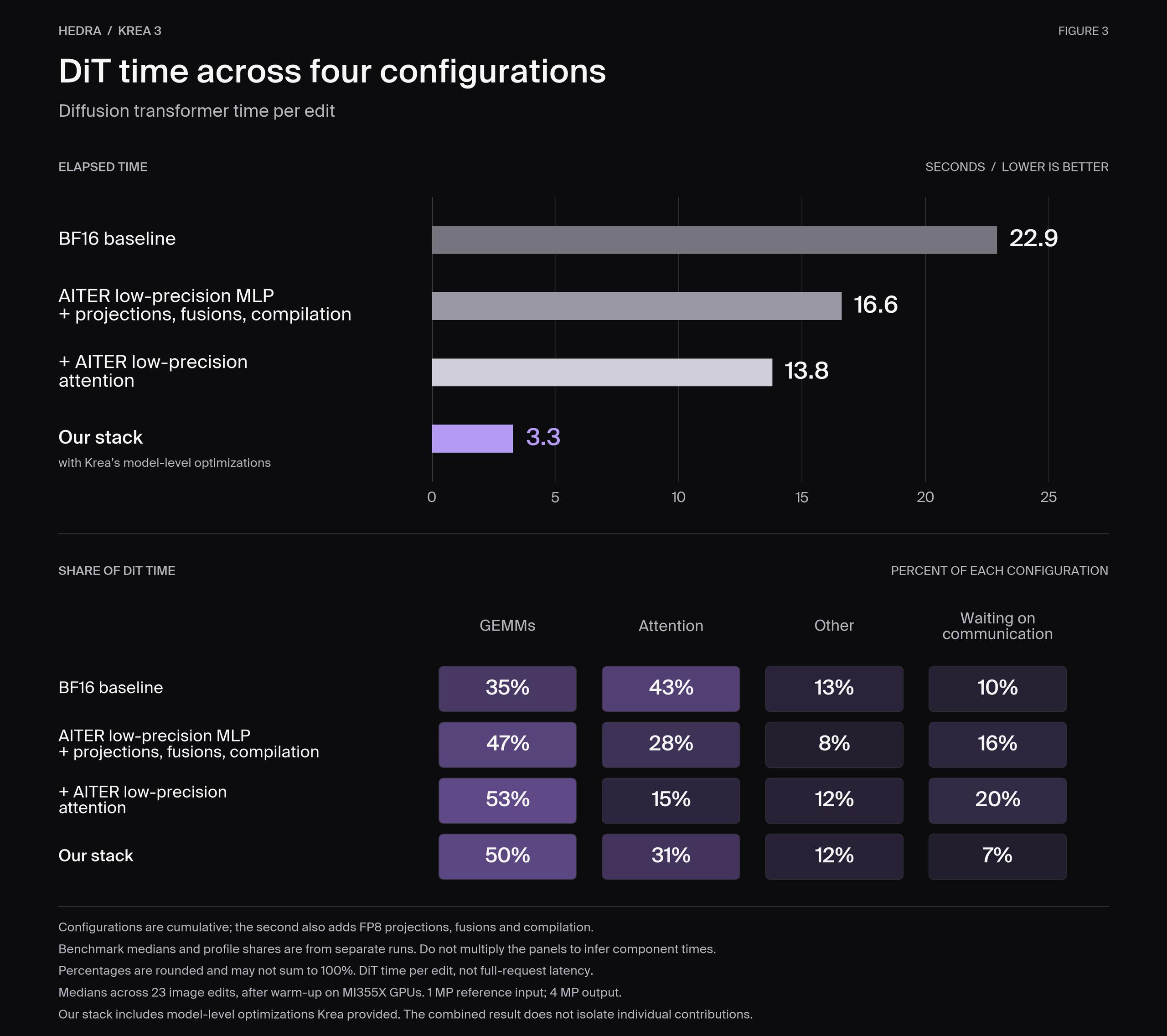
Figure 3. Diffusion transformer time per edit and each configuration’s reported profile shares. Each configuration adds to the previous; the second also adds FP8 QKV and output projections, output-projection gate and RMSNorm fusions, and compilation. Benchmark medians and profile shares are from separate runs, so multiplying the two does not give component times. Percentages are rounded and may not sum to 100%. These are DiT timings, not full-request latency. Times are medians across 23 image edits supplied by Krea, measured after warm-up on MI355X GPUs with a 1 MP reference input and a 4 MP output.
Make each round of research more capable.
Our ambition is recursive self-improvement: models that perform better in their applications, and AI Researchers that become better at developing and deploying those models. This research aims to improve data, training methods, inference software and GPU execution.
The recursive step is to use better models, agents and tools to improve the next round of research. Better agents can propose better experiments; better tools can make those experiments more useful. Each change must be evaluated against its objective before being used in subsequent experiments. The quality of what we learn matters as much as the speed of each research cycle.
Research objective: improve the whole system
Develop and train
Evaluate
Optimize and deploy
Production results inform the next experiment.
AI Researchers · Training methods · Inference software · GPU execution
Build intelligence you own.
Teams solving hard problems should own models that reflect their domain. As data, operating conditions and ambitions change, teams should be able to keep developing their models.
Deployment must also fit the model's operating conditions. Physical systems have response-time constraints, so model optimization, inference software and compute placement have to be designed together. We're building toward distributed, low-latency deployment, with compute on premises or close to the application.
Using a model in production provides evidence of where it fails, which behavior needs to change and what data the next training run requires. This evidence feeds back into post-training and evaluation for the next version of the model.
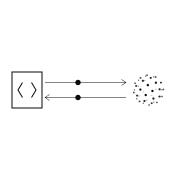
This is why we're building Model Factory.
Model Factory brings our forward deployed researchers, agents and GPU infrastructure together to post-train multimodal models through supervised fine-tuning or reinforcement learning, optimize inference and serve those models in production.
