Precision
We compare lower-precision formats with a higher-precision baseline to find the fastest option that meets the quality target.
Output quality sets the limit on how far we can lower precision. We profile multimodal workloads to find where kernel tuning and changes to GPU communication can reduce inference time.
| Format | SSIM | vs. rerun |
|---|---|---|
| BF16 rerun | 0.962 | Reference |
| FP8 | 0.954 | 99.2% |
| MXFP6 | 0.946 | 98.3% |
| MXFP4 | 0.858 | 89.2% |
SSIM against BF16 output across 23 image edits. Target: within 2% of the BF16 rerun. MXFP6 met the quality target and ran the MLP faster than the best FP8 implementation. Krea 3 engineering write-up.
We compare lower-precision formats with a higher-precision baseline to find the fastest option that meets the quality target.
We test how to split work across GPUs and measure whether the time saved in computation outweighs the cost of moving data between them.
We overlap transfers with computation so GPUs spend less time waiting for data.
We tune existing kernels for the model’s operations and build custom ones where we can make better use of the GPU’s memory hierarchy.
We chose MXFP6 for Krea 3’s MLPs. It ran faster than our best FP8 implementation and met our quality target against a BF16 rerun. MXFP4 fell short on quality.
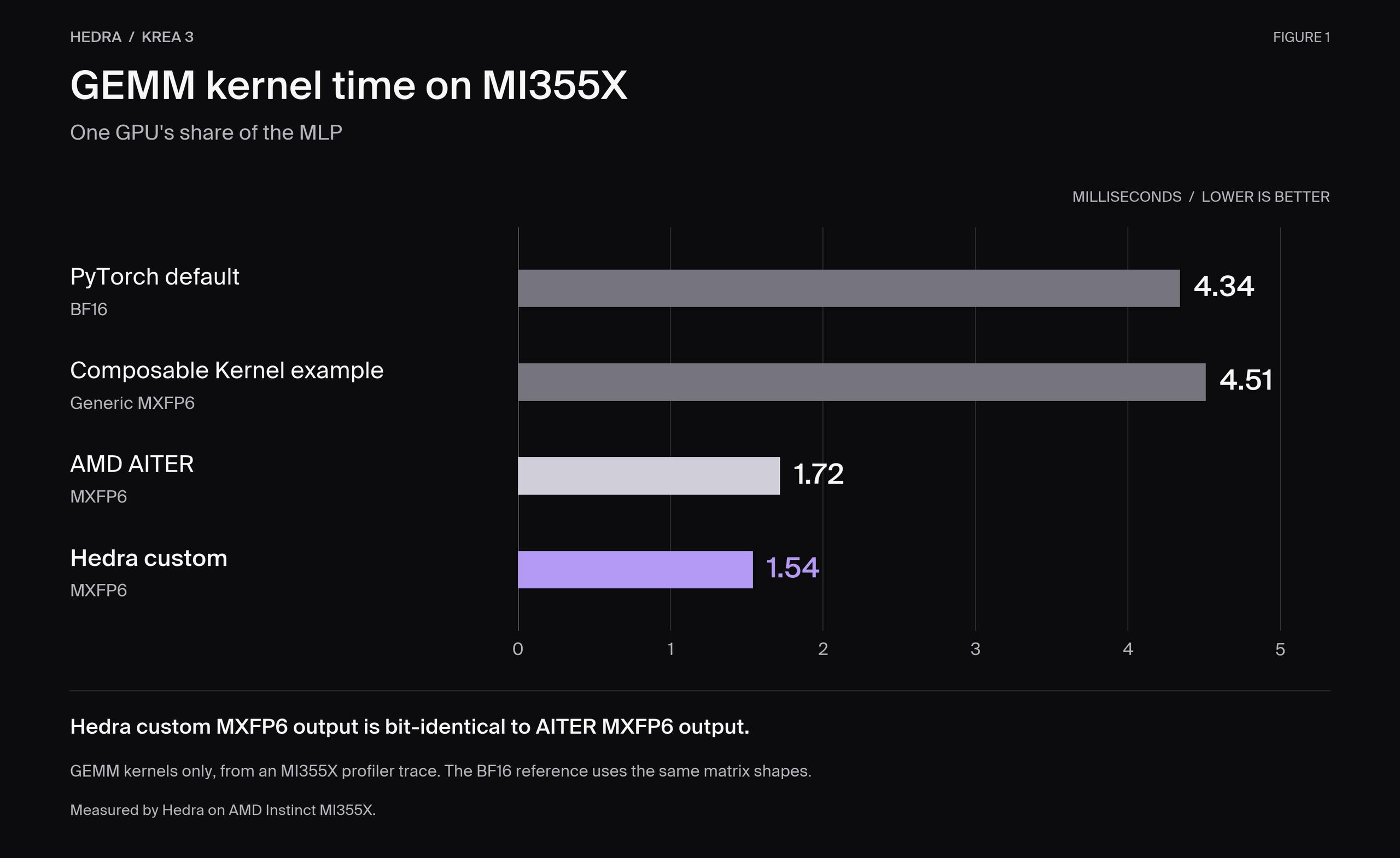
Figure 1. GEMM kernel time for one GPU’s share of the MLP. Timings come from a profiler trace on MI355X and cover GEMM kernels only. The BF16 reference uses the same matrix shapes. Lower is better.
AI Researchers also tested fusing small operations into matrix multiplications. Those experiments showed no speedup.
Median DiT time per edit
22.9 s → 3.3 s
For Krea 3, median DiT time per edit fell from 22.9 s to 3.3 s for a 1 MP reference and 4 MP output on AMD Instinct MI355X GPUs, combined with model-level optimizations Krea provided. This measures DiT time, not full-request latency.
Medians across 23 image edits supplied by Krea, measured after warm-up.
Before · 22.9 s
After · 3.3 s