Recursive self-improvement
We study how results from one round of experiments can improve the models, AI Researchers and infrastructure used in the next.
We study how multimodal models learn, how to steer their behavior and how to make inference faster. We’re developing AI Researchers to run experiments and use the results to decide what to test next.
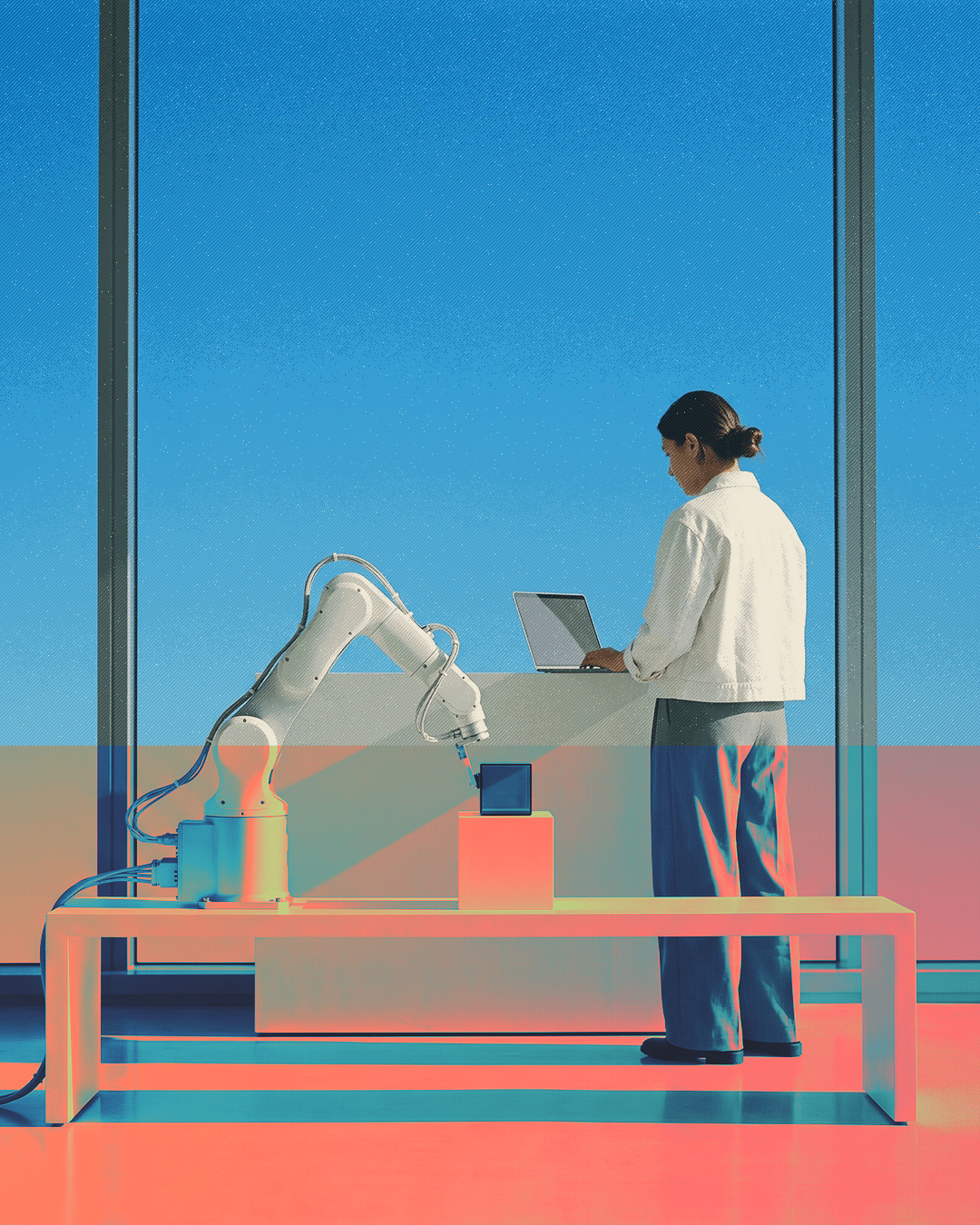
We study how results from one round of experiments can improve the models, AI Researchers and infrastructure used in the next.
We study how models represent concepts internally and how to steer one concept without disrupting other learned behavior.
We adapt multimodal models with supervised fine-tuning and reinforcement learning, then evaluate whether they behave as intended.
We optimize GPU kernels and test how numerical precision affects inference speed and output quality.
Model ·
Michael Lingelbach
Omnia brings vision, text and audio into one world model. It’s designed for partners to adapt with their own data and evaluate against their own goals.
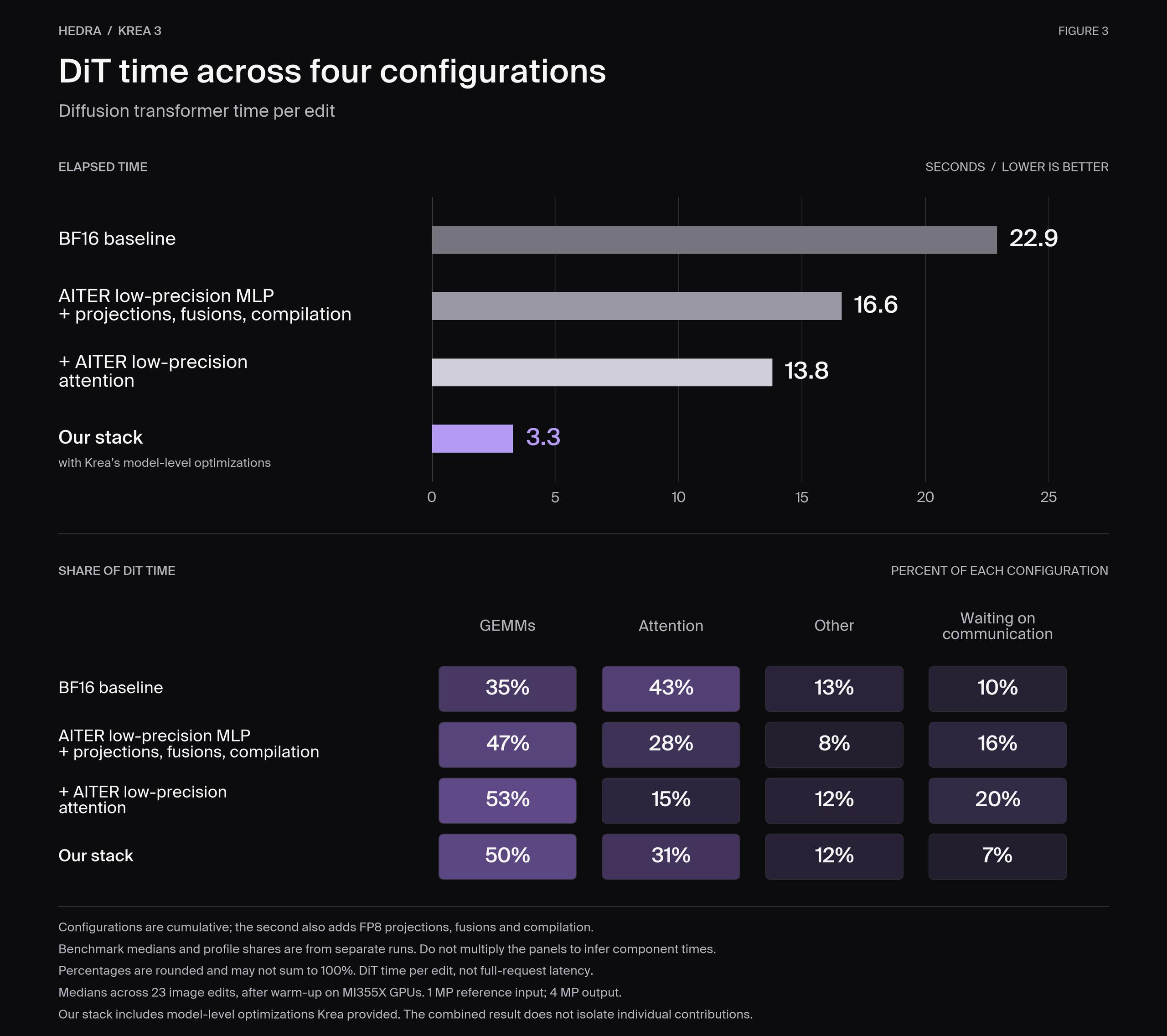
Figure 3. Diffusion transformer time per edit and each configuration’s reported profile shares. Each configuration adds to the previous; the second also adds FP8 QKV and output projections, output-projection gate and RMSNorm fusions, and compilation. Benchmark medians and profile shares are from separate runs, so multiplying the two does not give component times. Percentages are rounded and may not sum to 100%. These are DiT timings, not full-request latency. Times are medians across 23 image edits supplied by Krea, measured after warm-up on MI355X GPUs with a 1 MP reference input and a 4 MP output.
Inference ·
We optimized Krea 3’s image-editing inference on AMD Instinct MI355X GPUs. AI Researchers tested GPU transfers and operation fusion on third-party cloud GPU VMs.
Evaluation ·
Michael Loh
We replay multi-turn conversations with simulated media generation to test which tools the agent chooses and how it references earlier assets.

