Unomundi's Mission to Unify Children Worldwide with Hedra
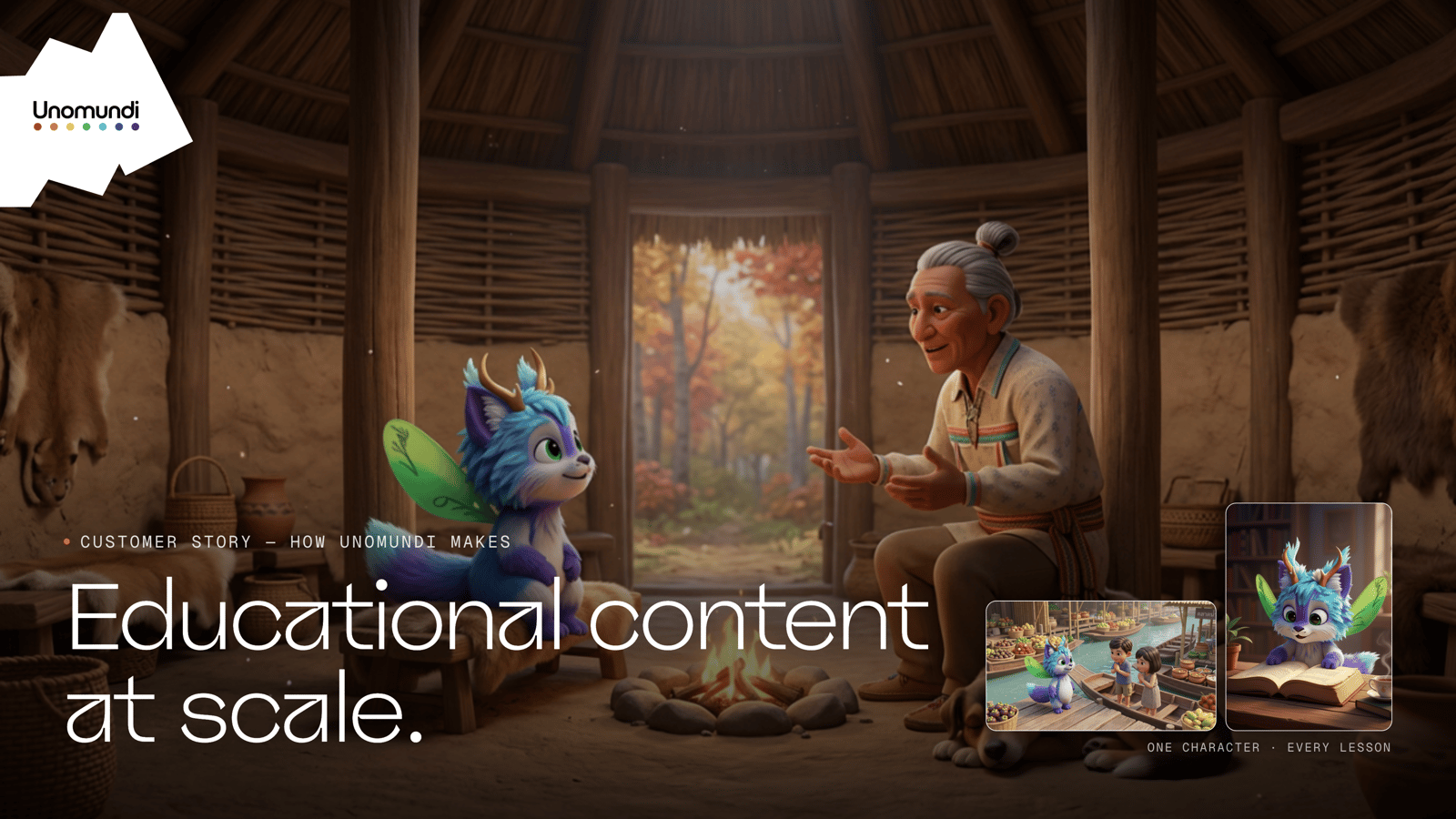
Customer Spotlight — Unomundi
Key facts from this interview:
- Unomundi is an education app designed for children to explore cultures around the world, guided by an AI character named Una. Its mission is to help children become global citizens and to better understand other cultures.
- The team has produced content covering 160 countries, with 30 to 60 minutes per country, built by three to four people working actively for less than half a year.
- Against internal benchmarks, Unomundi estimates the same library would have been roughly 40 times more expensive to produce without the tech stack they use and the timeline would have been extensive.
- Unomundi found Hedra by searching for alternatives to building a 3D character rig. Their creative director came from AAA gaming, where character animation assumes a AAA budget.
- The stack runs from a proprietary agentic flow (orchestrated with Anthropic, OpenAI, and Gemini) through ElevenLabs voice generation, streamed into Hedra Avatar. Documentary-style lessons are cut by an in-house video team; storyboarded cutscenes are assembled by an automated cutting agent.
- Real-world footage is never AI-generated. Only the narrating character is animated and composited over real documentary footage; fully AI-generated stories are deliberately stylized so they read as animation.
- For high-value scenes, the team generates the same start/end scene across Kling, and Veo from a single Hedra pipeline and picks the best result.
- A curriculum lead, cultural anthropologists, and behavioral scientists set the guardrails up front, and every piece is human-reviewed at the script stage and again at the final video stage.
Co-founded by Sonja, a technologist and mother of three, with a team representing 22 nationalities, it now has content spanning 160 countries produced by a handful of people in under six months. We sat down with Sonja to talk about their incredible mission, their content pipeline, and what it takes to use AI video responsibly when your audience is a child.
Sign up for Unomundi's free beta: https://www.unomundi.com/betasignup-hedra
What is Unomundi, and what problem is it solving?
Sandra: Tell me about what you're building.
Sonja: I'm a mom of three and a technologist. I believe the most important skill kids will need is not math or science or language. It's understanding other people and other cultures. In 20 years, when they run the world, the problems they face can't be solved by one country. Climate, geopolitics, whatever this AI hype does to our societies, they'll need to solve that as one world.
Right now, digital media isn't helping children develop those skills. Kids are being pulled into polarization. We're seeing increased xenophobia, tribal thinking, and nobody is really building for genuine global understanding.
So Unomundi is an app where kids explore the real world, guided by Una, our little AI companion. They can see what Tibet looks like, how people greet in Nigeria versus the UK. They learn how our brains work, why humans think in patterns, why prejudice quietly creeps in, and how to look at other people with curiosity instead of judgment. Later we'll connect them directly with peers, imagine pen pals for the digital age.
How did Unomundi find Hedra?
Sandra: How did you first hear about us, and what made it the right fit for a children's product?
Sonja: At the very beginning we started building a 3D model for Una. If you've ever built 3D models, that's a very intense process. And to get to the quality level we needed, to really immerse children in a world without algorithmic dark patterns it had to be high. Our creative director and co-founder comes from the AAA gaming world, so he's used to huge budgets for this. As a bootstrapping startup, we didn't have that. So literally, we Google searched alternatives to animate 3D characters. That was more than a year ago. It's been really amazing to see the evolution of Hedra over the course of the last year and how you've optimized your models. But that was the initial need: to animate a character without going through the pains of building a 3D model.
As for children's content: many models hallucinate in really creepy ways. We needed to build a huge amount of content on a small budget, with a small team, in a very short amount of time. The quality of the Hedra animation, and the ability to trust that we could start doing it programmatically without redoing it over and over, that's why it fit.
What does Unomundi's production workflow look like?
Sandra: Walk me through the workflow, from a story idea to something in the app.
Sonja: The most important part in all of this AI hype is still the humans. At the beginning, our cultural anthropologists, behavioral scientists, and curriculum lead define the guardrails and the curriculum intention. They work with an agentic backend — script and learning-goal generation, then safety guardrails, cultural authenticity layers, developmental psychology layers. All of that is proprietary.
Then it goes into audio creation after review, and from there it automatically flows into Hedra. There are a few tailored promotional videos or high-value cutscenes where we go into the Hedra UI manually, but the majority is automated. Human input at the beginning, human review at the script stage, and human review again at the end.
Sandra: Do you generate the clips in Hedra and then assemble them elsewhere?
Sonja: There are different types of lessons. The majority of what we currently produce is Una narrating real-world footage. We animate the character, isolate her, and mask her into the cut. Think of it as a short documentary about different countries. There's a video team behind that type of content that takes the footage, cuts everything together, and overlays the animated character on top.
Then there's the storytelling animation, where we don't need any cutting at all, because it's literally one image animated end-to-end through Hedra. And then there's the level that needs more human work, where we're mostly in the UI animating the scenes on a storyboard. When we get those scenes back, though, the cutting is automated by a cutting agent.
What is Unomundi's AI video and audio stack?
Sandra: What tools are in the pipeline besides Hedra?
Sonja: We have an agentic flow in the background. But the providers we work with are Anthropic, OpenAI, and Gemini for general orchestration. ElevenLabs is the voice generation, we use it directly, and when we get the ElevenLabs stream we stream it back to Hedra. We're mainly using Hedra Avatar.
For the higher-value animation cutscenes, one of the beautiful things about Hedra is that we can work with different models from one single interface. One time we try Kling, then Veo, and the results are still very different. The ability to generate one start/end scene, one transition scene, across three models through one pipeline is really important.
Why generate the same scene across multiple AI video models?
Sandra: So which animation model do you use?
Sonja: All of them. I can only tell you which clip we'll use after I've seen it, because the results are vastly different.
One example: we had a scene explaining the traditional Māori greeting in New Zealand which is the sharing of breath, where foreheads touch. The start and end frames had a group of people leaving the gathering. We animated it with, I think it was Kling. And Kling decided the most reasonable way for these people to leave a grass field was for them to be beamed away. The model animated them and said, "It is time to leave," and they were beamed up. Seedream just made them walk away, which makes a lot of sense.
Those things still happen in AI, and that's where the humans come in. But I instantly had three versions across models, and I could just say: yep, that's it, cut it, done.
How do you produce content for 160 countries with a team of three or four?
Sandra: Was this kind of content possible before AI video?
Sonja: It's important to differentiate. Content where we show the real world is never AI-generated and we're never creating something that looks like a real place with AI, we're only narrating it with an AI character. And whenever we create stories with AI, they're clearly stylized, so it feels like an animation.
Was this possible before AI? Absolutely. What wasn't possible is doing it at this scale. We now have content for 160 countries, 30 to 60 minutes per country, with a team of maybe three or four people working on it actively, in less than half a year with review on every single piece.
If you imagine doing this without the technology we're using and we have the benchmarks for it it would be 40 times more expensive, and nobody knows how much longer it would take. That's the real differentiator: cost-effective and fast, without compromising on safety and authenticity.
Was there a moment when it clicked?
Sonja: We went very early into classrooms all over the world. One of the most memorable was when a colleague in Nigeria went into a Lagos classroom and showed videos with Una, and let the kids talk to Una as a conversational AI. Seeing how quickly they got immersed in really seeing the world was amazing. When the session was over, the kids were actually super sad — there were girls crying, saying, "When can you come back and show us more?"
A year later, the level of quality we're able to create using Hedra and the other technologies around it has such high production value that it never feels like a project. It's real and it would have been cost-prohibitive without technology like Hedra and the others coming into the mix.
How does Unomundi measure whether the content works?
Sandra: You've committed to no ads in the app. So how do you measure success?
Sonja: To clarify, we don't run ads in the app; we do run ads for acquisition. We measure engagement like any other app: retention. Inside the app we ask kids how something made them feel. There are quizzes like "Do you remember how people greet in New Zealand?" and so we measure retention of the material. And if parents allow conversational AI, the AI asks children what they thought and how it relates to their own experience.
We don't store the actual conversations. We meta-analyze whether children are getting more curious, forming positive opinions, and retaining critical thinking.
What are the current limitations of AI video for children's media?
Sonja: The further a character gets from a human, the harder it is for AI to animate. Our wise old tortoise, Sophia, has been a real nightmare for the team, because a tortoise doesn't have the features our lead character has.
There's also an opportunity to further reduce hallucinations. With over-the-shoulder shots, no matter how you prompt your little heart out, the character who isn't in frame can suddenly turn around and be some creepy alien. Models can still learn so much there and what a wonderful opportunity to get consistency without having to train a model on your specific character.
Where is AI in children's media heading?
Sonja: The cards are still being shuffled. There's a lot of debate about where the ethical lines are for using AI with children, and we're all learning. How do children react to AI? How much is good, and when does it get harmful? Those are things we don't yet know. Like with screen time, there's a broad spectrum of opinions across both the scientists and the parents, and we'll need to find a good balance. It's just too soon to know what is still a good use of AI with kids.
Here's what I can say: children form attachment to AI characters much faster than adults do. Their brains aren't yet wired to understand the difference between a fake character and a real one, especially at a younger age. When you look at six to eight year olds, the reason they still beautifully believe in Father Christmas and the Tooth Fairy is that their brains aren't developed enough yet. That means it's a huge responsibility when you build characters and worlds to help their brains develop, and not unintentionally harm them.
My hope is that we use AI in a way that honors every individual child. The reality is that with the lack of regulation, there's a lot of opportunity right now to abuse the power AI gives to get kids hooked. We consciously don't use those routes, and there are many others like us who choose the ethical path even though it's harder.
What's next for Unomundi?
Sonja: We release on YouTube every Friday, in English and in German. The closed beta is open for families to join at unomundi.com/beta. As we move into open beta it'll be in the public app stores later this year with new content every week.
Frequently asked questions
How much content can a small team produce with AI video?
Unomundi built content covering 160 countries, 30 to 60 minutes per country with three to four people working on it actively for less than six months, including human review of every piece by cultural anthropologists and behavioral scientists.
How much cheaper is AI video than producing the same content without it?
Against internal benchmarks, Unomundi estimates its library would have been roughly 40 times more expensive to produce without the technology stack it uses and that the timeline would have been unpredictable. The team's original alternative was building and animating a 3D character rig.
Is AI-generated video safe for children's content?
Unomundi's approach is to constrain what AI generates. Real places are shown as real footage, never AI-generated; only the narrating character is animated. Fully AI-generated stories are deliberately stylized so children read them as animation. Its agentic backend applies safety, cultural authenticity, and developmental psychology layers, and humans review every script and every finished video.
How do you animate a character without building a 3D model?
Unomundi animates its lead character Una from a single image using Hedra Avatar, driven by voice audio generated in ElevenLabs and streamed programmatically into Hedra. For storytelling scenes, one image is animated end-to-end with no cutting required removing the need for a 3D rig entirely.
Why use more than one AI video model for the same scene?
Model behavior on identical prompts varies dramatically. Unomundi generates the same start/end scene across Kling, Seedream, and Veo through a single Hedra pipeline, then chooses the best result in one case, one model had characters walk away from a gathering while another beamed them into the sky.
What does an automated AI video pipeline look like end to end?
Unomundi's flow: human curriculum and guardrail definition → agentic script generation (Anthropic, OpenAI, Gemini) with safety, cultural authenticity, and developmental psychology layers → human script review → ElevenLabs voice generation → programmatic hand-off to Hedra Avatar → assembly, either by an in-house video team or an automated cutting agent depending on the lesson type → final human review.