Texas Rangers Revolutionize Fan Engagement with Hedra
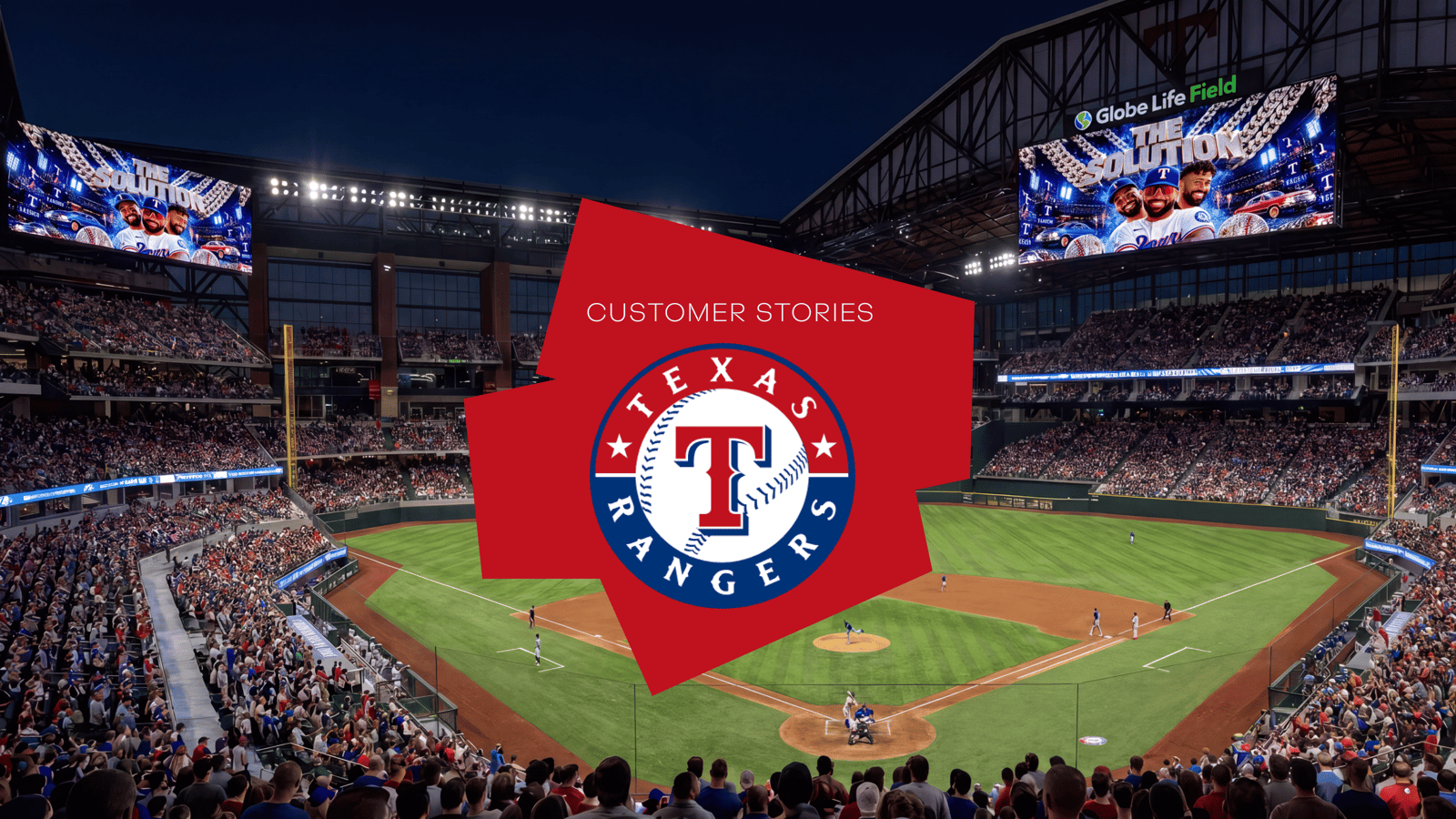
The Texas Rangers' ballpark entertainment team is responsible for almost everything you see and hear at a home game including the video board, the music, the mascot and the promotions. It's a small group producing an enormous amount of content across 81 home games a season, and over the past year Hedra has become a fixed part of their workflow. It started with a TikTok trend and a video of the team's TV announcers turned into babies, and it grew into a tool they use daily in their content creation workflows.
We sat down with Chris DeRuyscher, Colin Drake, and Brian Contreras to talk about how a Major League Baseball entertainment team actually uses AI video from mascot animations to render-engine tricks and why they see it as a creative multiplier rather than a threat.
Key facts
- The Texas Rangers ballpark entertainment team produces the in-stadium show for 81 home games a season including video board features, mascot content, in-game graphics, and promotions.
- The team discovered Hedra through a TikTok trend and built their first feature around it: turning their TV broadcasters into babies calling big moments from the season, which drew laughs from announcers and fans alike.
- Their workflow now runs ChatGPT → Hedra → Adobe (Premiere and After Effects), with Hedra used both to animate still images and, creatively, as a render engine to fill in frames on projects too heavy to render conventionally.
- Hedra has replaced work that would have cost thousands of dollars or taken days of manual animation and a graphic that once would have taken days in Cinema 4D and After Effects now takes 10–15 minutes with a prompt.
Who's on the Texas Rangers ballpark entertainment team, and what do you do?
Chris: "I'm the head of our department, which is ballpark entertainment. We're in charge of production and promotions here at the Texas Rangers, promotions being bobbleheads and t-shirts and all that kind of stuff, and the production side is everything you'd see on the video scoreboard: the music, our team mascot, all those kinds of things. Ultimately, we're in charge of entertaining people. Whether the team on the field is winning or losing, it's our job to make sure fans have a great time and want to come back."
Colin: "I'm Colin Drake, director of in-game production and design. I oversee the game-in-progress look basically what you see while the game is going on. In baseball, you see it a lot, because the board has to be static: a bunch of stats on the board, making sure they're coming in as they're supposed to, developing prompts, inning-break features, things like that."
Brian: "I'm Brian Contreras, in-game productions and design coordinator. I help create content with Colin, and more specifically I help create the in-game graphics with player headshots, stats, and notes that fans see on the video board during the game."
How did you first hear about Hedra?
Brian: "I actually found it just watching TikTok. There was a trend going on where people were taking shows and making babies out of the characters. So I researched how people were doing that, and people were talking about Hedra and this new AI software they were using to make the babies talk. That's where the idea for our first feature came from."
What was the first thing you made with Hedra?
Brian: "We came up with the idea last year of having our TV announcers turn into babies, calling big moments from the season. It went really well. Our announcers were laughing, our fans were laughing. We had people posting about it online, and our broadcasters got a real kick out of it."
Colin: "The way our board works, it's basically a rectangle. If we put a 16:9 clip in there, we have extra space that would just be black. So because we were using the broadcast feed, which is shot 16:9, we did the whole edit of the big play off to the side, the baby announcers on screen, audio being their adult voices doing the call, but visually them as babies doing the play. It seemed like at the time, that's what Hedra was doing. It was very early stages, and just watching it grow to what it is now, it's a lot more."
What other kinds of content have you created with Hedra?
Chris: "Early in the year we have spring training, where the team gets together and starts practicing for the season. We go down there and do a lot of player content on green screens, but there's a lot of waiting around, and that's when these guys really started playing with it. The World Cup was coming, so we thought, what if we turned our baseball players into soccer players? Colin went down all kinds of rabbit holes with it. That's when we really saw what Hedra could do for us in-game — because there's only three of us and a couple of editors, and we try to churn out as much content as we can. With Hedra, even I can do it, and I'm not good at this stuff."
Colin: "The thing on the top of my mind is what I'm working on now — taking our mascot, Captain. He's a horse who wears a baseball jersey just like the team on the field, and I'm turning him into a Pixar-like 3D character, creating crowd prompts, popping him out of our game-in-progress look and having him fakely interact with structures already in the scene. That's been a great part of it, because sometimes it's tough to film him in front of a green screen. Being able to just take a still image into Hedra and tell it what to do has been awesome."
Credits: RSN Jr. footage courtesy of Rangers Sports Network.
What does your typical workflow look like, from idea to the video board?
Brian: "It's probably a little all over the place for the three of us, but the general idea is you have an idea, you create it, and then you take that video file and send it to the control room where it's played. Stepping back further: at Major League Baseball we have an internal ChatGPT license we use to create images. So I'll take my idea, type it out, create a still image, and then take that still image into Hedra and animate it or do whatever I need to do. From there I take them into Adobe Premiere or After Effects and edit, and then we send those files to our control room to display on the video boards."
Colin: "On the mascot project, I took photos our team photographer had taken in-studio of Captain — front, side, both sides, back. I uploaded all of those to ChatGPT and asked for a Pixar version, and immediately got images. It even spit out a style guide — here's your style guide for your 3D Pixar Captain. Then I took all of that over to Hedra and started iterating. A lot of these mascot photos I've cut out and put on green, gotten Hedra to do the animations with a solid green background, and keyed it in After Effects to get my alpha channel back — so we can do some other smoke-and-mirrors magic to make it all look like part of a live scene on the boards."
You've also used Hedra as a render engine. How does that work?
Colin: "We have our starting-lineup open with five-second interstitials and player headshots. It was getting down to crunch time when the season started, and I work in Cinema 4D using Octane render on that project. The scene was really heavy — frames were five or six minutes a piece — so the math just wasn't going to work out rendering straight out of Cinema 4D. So I looked at Hedra as a render engine. I rendered the first frame, a middle frame, and a last frame of the 11 versions of the interstitial I needed, then ran it all through the same model with first-frame/last-frame to render everything in between and get the whole camera-movement animation. They all turned out pretty much exactly the same, and it saved a bunch of time. Working smarter, not harder, as Chris likes to say."
Colin: "I've been finding cheaper ways to get things done, too. I'll render out at 480p — the cheapest option — then use After Effects' upscaler, which is very solid and will almost make it look like 4K. Then in Premiere you can drop it into a 60-frame timeline, and Premiere's AI can fill in the frames to turn 24p into 60p, which is what our video boards run. The 24 is fine, but seeing something at 60 frames per second on the board really adds that extra pop."
How has Hedra changed the way your team produces content?
Chris: "It's allowed us to do things within our entertainment show that financially we would not have been able to do. There's only so much budget every year, and we're expected to do most everything in-house. Hedra has changed the way we can provide graphics and different things more timely — is it a Harry Potter theme day, a Star Wars theme day? Things we wouldn't have had time for before. It's been a time saver, it's given us creative flexibility, and it's taken what we can create to a whole other level."
Brian: "It's the speed and what we can do. For our starting-lineup open, we have a graphic where a billboard explodes out of the ground. That's something Colin and I probably could have done in Cinema and After Effects, but it would have taken us a few days just to get that animation. Just typing that prompt into Hedra — 10, 15 minutes — you have some amazing animation that could have taken us days to do."
Chris: "In American baseball there are 81 home games, which is more than double basketball or hockey. So we have to come up with a lot of content, and it would cost thousands and thousands of dollars to have some of this done outside. There are only so many of us and so many hours in a day. Hedra has helped us create content and animations quickly, and everything looks really sharp."
Do the AI-made features actually land with fans?
Chris: "I don't know about conversion metrics — we kind of go by, did people laugh? Did they cheer? Did they cry? The crowd prompts get great feedback. The baby announcer feature got really good feedback; we had people posting about it, and our broadcasters were talking about it. Nowadays some people are really against AI, but we haven't gotten any negative feedback. We still do a lot of our own stuff — it's not like every aspect of our show is AI."
Colin: "I'd say we use it more as another tool in the toolkit. Almost nothing we put on the board is 100% AI — it's some part of the whole composition. And that's the trick: making the AI not look like AI, because you don't really want it to feel like AI."
Where do you see AI video going for creative teams?
Chris: "I think it's up to every organization to decide that people are more important than machines, and we as a world have to continue with that idea. But I couldn't do without either of these two guys — Hedra and other AI aren't going to replace them, because there's so much of what we do that a machine can't do. We're not afraid of it. We don't look at it as working ourselves out of a job. We look at it as, we can do this cool thing, and that cool thing, and double the amount of work and really show people we know what we're doing. Any organization would love a product that can double the work and that everybody loves. Creativity is only limited by what you think of."
Colin: "The projects aren't 100% AI — there's still people skill and mind skill to put it all together. It starts with the idea, then figuring out how to composite it all, then knowing how to export it correctly for the video boards. I see it as a great tool that's one more thing to improve what we do for the fan experience."
Brian: "A year ago I felt like all you could do was voiceovers or very limited stuff. Less than a year later, you can make a commercial using Hedra. It's exciting to see what we'll be able to do a year from now to make more content and bring more energy to the ballpark."
What are the current limitations?
Chris: "You have to know what you're doing to a degree. You could sit there and spend a lot of money spinning your wheels and it's all looking like garbage. It takes somebody who has a pretty good idea of the broadcast world, or how to create in general — this shot, this sound effect, this, this, this."
Colin: "There are certain times where I couldn't get the exact right prompt to get it to do what I wanted, and I ran out of time and had to move on — though I'd say that's probably user error on my part more than anything. Once I found the enhance button and saw the prompt it made, I was able to take that and create different prompts from it. The other tricky thing is compositing: if I could put the six or seven generations together, I'd have all the pieces I need, but they're each a little bit different, so editing them together seamlessly is the challenge."
How often are you using Hedra now?
Chris: "We use it daily — well, daily, every other day, truly. It's our go-to now. That workflow — ChatGPT, Hedra, Adobe, After Effects — Hedra is right in the middle of all my projects, and I'd guess it's right in the middle of these guys' projects too. Right now we're big fans, we've tried to tell other teams about it, and we plan on using it for a while."
Credits: RSN Jr. footage courtesy of Rangers Sports Network.
FAQ
How does a sports entertainment team use AI video? The Texas Rangers ballpark entertainment team uses Hedra to create video board features, animate their mascot, build in-game graphics, and produce content for all 81 home games. Their workflow runs from ChatGPT (for still images) into Hedra (for animation) and into Adobe Premiere and After Effects (for final editing and compositing).
What was the Rangers' first project made with Hedra? A feature turning their TV broadcasters into babies calling big moments from the season, inspired by a TikTok trend. It played on the stadium's main video board and drew laughs from both announcers and fans.
Can AI video actually save a small creative team money? Yes. The team estimates that content which would have cost thousands of dollars to produce externally, or taken days of manual animation in Cinema 4D and After Effects, can now be produced in minutes to hours with Hedra.
Can Hedra be used as a render engine? Yes. On a scene too heavy to render conventionally, the team rendered a first, middle, and last frame, then used Hedra's first-frame/last-frame generation to fill in the animation between them — producing consistent results and saving significant time.
Will AI replace creative teams? The Rangers' view is no. They treat AI as another tool in the toolkit — most of what they put on the board is only partly AI — and see it as a way to expand creative output rather than reduce headcount. As they put it: creativity is only limited by what you think of.
Want to build creative workflows like the Texas Rangers'? Explore Hedra.