AI Content Creation: A Complete Guide to Scalable Visuals
AI content creation has evolved from a text-generation experiment into the backbone of modern marketing, powering everything from product photography and video ads to full campaign production. About 94% of marketers plan to use AI in their content creation processes in 2026 (HubSpot, 2026). Yet most guides on this topic still focus narrowly on blog writing tools and caption generators.
The real transformation is happening in visual content. Product photos, branded videos, social media graphics, and ecommerce assets are where AI delivers the highest return on investment and where businesses of all sizes stand to gain the most.
This guide covers the full spectrum of AI content creation, with a focus on the visual and ecommerce use cases that other resources overlook. Whether you run a Shopify store, manage social media for a growing brand, or create content for a global audience, you will find practical strategies to produce more content, faster, without sacrificing quality.

What Is AI Content Creation (and Why It Is Bigger Than Blog Writing)
AI content creation is the use of artificial intelligence to generate, edit, and optimize digital content across formats, including text, images, video, audio, and graphics. It is powered by machine learning models that analyze inputs like text prompts, reference images, or brand guidelines and produce polished outputs in seconds.
Most people associate the term with writing assistants that draft blog posts or social media captions. That definition was accurate in 2023. It is incomplete in 2026.
The Evolution from Text Generators to Visual Content Engines
The generative AI content creation market was valued at USD 14.8 billion in 2024 and is projected to reach USD 80.12 billion by 2030, growing at a compound annual growth rate of 32.5% (Grand View Research, 2025). That growth is not driven by text alone.
Multimodal AI tools now generate text, images, video, and audio from a single platform. This shift means a marketer can describe a product ad in plain language and receive a finished visual, not just a paragraph of copy. About 75% of marketers now rely on AI for video and image creation, making visual content one of the leading AI applications in marketing (Typeface, 2026).
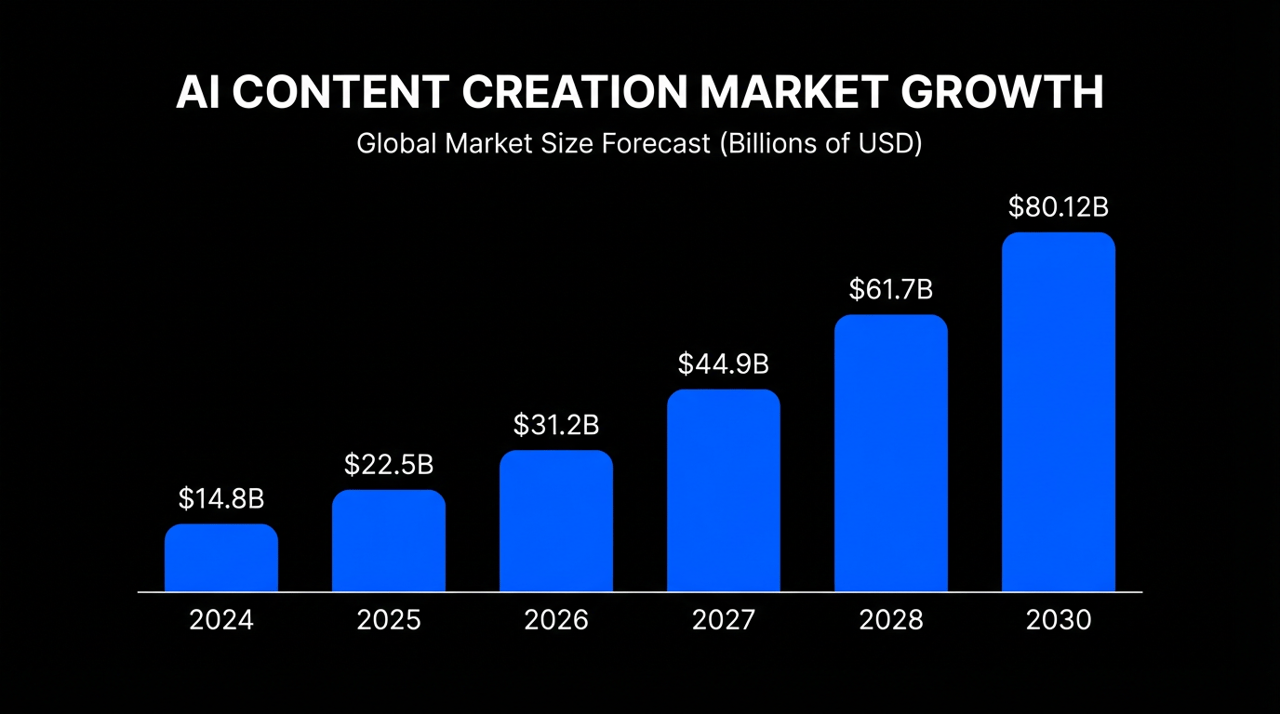
The text generation segment still accounts for the largest share of AI-created content. But visual content is where the growth rate is steepest and the business impact is most measurable, particularly for ecommerce and social media.
Types of Content AI Can Create Today
AI content creation now spans far more formats than most businesses realize. Here is the full landscape:
Content Category | Examples | Best For |
|---|---|---|
Text | Blog posts, ad copy, email campaigns, product descriptions | SEO, email marketing, social captions |
Images | Product photography, lifestyle shots, social graphics, thumbnails | Ecommerce listings, social media, ads |
Video | Short-form video, product demos, animated ads, AI video | TikTok, Reels, YouTube Shorts, product pages |
Audio | Voiceovers, podcast intros, narration | Explainer videos, audiobooks, ads |
Multimodal | Full campaigns combining images, video, copy, and graphics | Product launches, seasonal promotions, brand campaigns |
The most significant shift in 2026 is the move from single-format tools to multimodal platforms that handle video generation alongside image creation and copy, all within one workflow. This is where the highest efficiency gains come from, and where the rest of this guide will focus.
AI Content Creation for Ecommerce: Product Photos, Ads, and Listings
For ecommerce businesses, visual content is not optional. It is the product page. When a shopper cannot touch, hold, or try a product, the image does all the selling.
More than 67% of online shoppers consider the quality of product photos more important than product descriptions or customer reviews (ElectroIQ, 2025). And high-resolution product images result in a 33% increase in conversion rate compared to low-quality alternatives (BlendNow, 2025).
The problem is that traditional product photography is expensive, slow, and difficult to scale. A single studio photoshoot can cost thousands of dollars and take weeks to coordinate. For a small business with hundreds of SKUs, that math does not work.
AI content creation solves this by turning one product photo into a full library of assets.

Turning a Single Product Photo into a Full Asset Suite
The most practical AI content creation workflow for ecommerce starts with a single product image. From that one input, AI tools can generate:
- Lifestyle shots that place the product in realistic settings using dedicated image models (a kitchen counter, a living room shelf, an outdoor scene)
- White background catalog images with professional lighting and shadow correction
- On-model photography that shows clothing or accessories on AI-generated models of diverse body types, with options like face swap for adapting visuals across campaigns
- Image-to-video clips powered by video models like Kling AI that add subtle motion to product photos for social media and listing pages
- Multiple angles and variations without re-shooting
This is the workflow that turns a bootstrapped Shopify store into a brand with premium-looking visuals. No photographer, no studio, no weeks of turnaround.
For businesses selling on Amazon, Etsy, or their own storefronts, the impact is measurable. Retailers adopting AI-powered visual tools report annual revenue uplifts at a rate of 87%, and businesses implementing AI image solutions have seen up to 25% increases in sales (AutoPhoto, 2025).
Seasonal Campaigns and Promotional Content
One of the most time-consuming tasks in ecommerce marketing is creating seasonal content. Every holiday, every promotion, and every trend requires fresh visuals. Traditionally, this means new photoshoots, new designs, and new production timelines.
AI content creation compresses that cycle from weeks to minutes. A product photo taken in January can be placed in a Valentine's Day setting, a summer beach scene, or a holiday gift-wrap context without re-shooting anything. The same base image generates dozens of variations for different campaigns, audiences, and platforms.

This capability is especially valuable for small businesses that cannot afford to produce new creative for every promotional window. A local boutique can create Black Friday video ads from existing product photos in an afternoon, rather than hiring a production team months in advance.
Platform-Ready Assets Without Manual Resizing
Every platform has its own image and video specifications. Instagram favours square and vertical formats. LinkedIn performs best with horizontal images. TikTok and YouTube Shorts require 9:16 vertical video. Amazon has strict listing image requirements.
Manually resizing and reformatting content for each platform is tedious and error-prone. AI content creation tools handle this automatically, adapting a single creative direction across every platform in seconds.
This matters because short-form video delivers the highest return on investment among all video formats, outperforming long-form video and live-action content (Typeface, 2026). If your product content is not formatted for Reels, Shorts, and TikTok, you are leaving the highest-performing channel on the table.
AI Content Creation for Creators and Marketing Teams
The ecommerce use cases above apply to any business selling products online. But AI content creation is equally transformative for creators building audiences and marketing teams managing brand presence across channels.
Social Media Content at Scale
Content with images receives 94% more views than text-only content (West London Studio, 2026). And 85% of people say a video has influenced their decision to buy a product or service (Typeface, 2026).
For creators and social media managers, the challenge is not knowing this. The challenge is producing enough visual content to keep up with posting schedules across multiple platforms.
AI content creation addresses this by enabling:
- Batch production of branded social graphics from a single brief or reference image
- Text-to-video generation that turns a product concept or trend into a finished short-form video
- Content repurposing that transforms a long-form video into clips, a blog post into a carousel, or a product photo into an AI-generated UGC-style video
- Trend-responsive content that captures a viral format in your brand's visual style before the trend fades
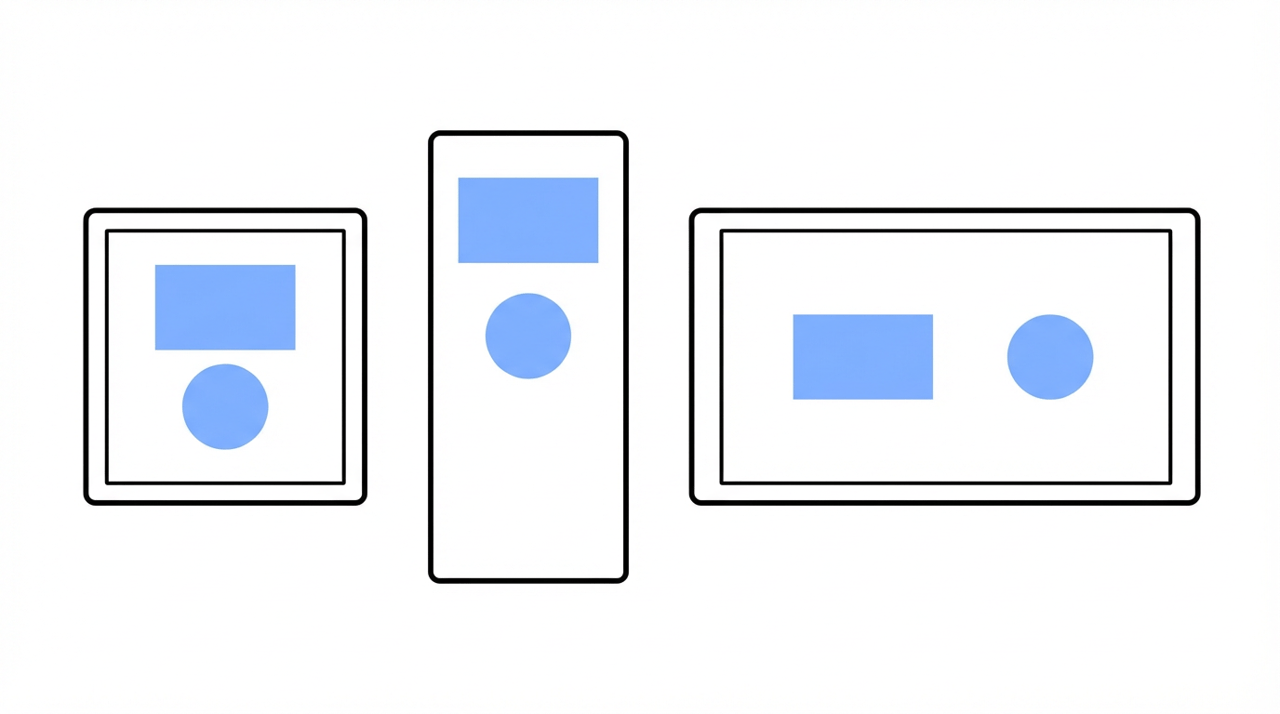
The goal is not to replace creative thinking. It is to remove the production bottleneck that sits between an idea and a published post. A creator who previously spent four hours editing a single video can now produce three to five polished pieces in the same time.
Brand Consistency Across Every Asset
One of the most common problems with scaling content production is visual drift. When multiple tools, freelancers, or team members produce content independently, the brand's look and feel starts to fragment. Colours shift. Fonts change. Logo placement becomes inconsistent.
AI content creation solves this with Brand Kits. A Brand Kit stores your logo, colour palette, typography, and visual guidelines in one place. Every asset the AI generates, whether it is an image, a video, or a social graphic, automatically applies these elements.
This is not just about aesthetics. Brand consistency builds recognition and trust. When a customer sees your content on Instagram, then visits your website, then receives an email, the visual identity should feel unified. AI-powered Brand Kits make this automatic rather than manual, even when producing dozens of assets per week.
Platforms like Hedra enable teams to upload brand assets once and apply them across every output, ensuring that the creative direction changes while the brand identity does not.
From Tool Overload to Unified Workflows
Most AI content creation guides hand you a list of fifteen tools. One for writing, one for images, one for video, one for resizing, one for scheduling. Each with its own login, its own brand settings, and its own learning curve.
This approach creates more friction, not less. According to HubSpot, 35% of marketers say there are too many AI tools that all do the same thing but do not connect to one another (HubSpot, 2025).
The Problem with Juggling Five AI Tools
Here is what a typical multi-tool content workflow looks like today:
- Write copy in one AI writing tool
- Generate an image in a separate AI image generator
- Create a video version in a third tool
- Resize for each platform in a design app
- Add brand elements (logo, colours, fonts) manually in yet another editor
Each step requires re-uploading assets, re-entering brand information, and context-switching between interfaces. The time savings from AI in step one get consumed by the friction in steps two through five.
How AI Agents Handle End-to-End Content Production
The emerging alternative is an AI agent that handles the full workflow in a single conversation. Rather than switching between five tools, you describe the outcome you want and the agent figures out the how.
This is not a theoretical concept. About 19% of marketers are already using AI agents to automate marketing initiatives from end to end (HubSpot, 2026). And 61% of marketers believe that marketing is experiencing its biggest disruption in 20 years because of AI (HubSpot, 2026).
An AI agent for content creation works like this: you describe a product ad campaign. The agent selects the right models, generates images and video, applies your brand kit, adapts outputs for each platform, and iterates based on your feedback. The entire process happens in one conversation, with full context retained at every step.
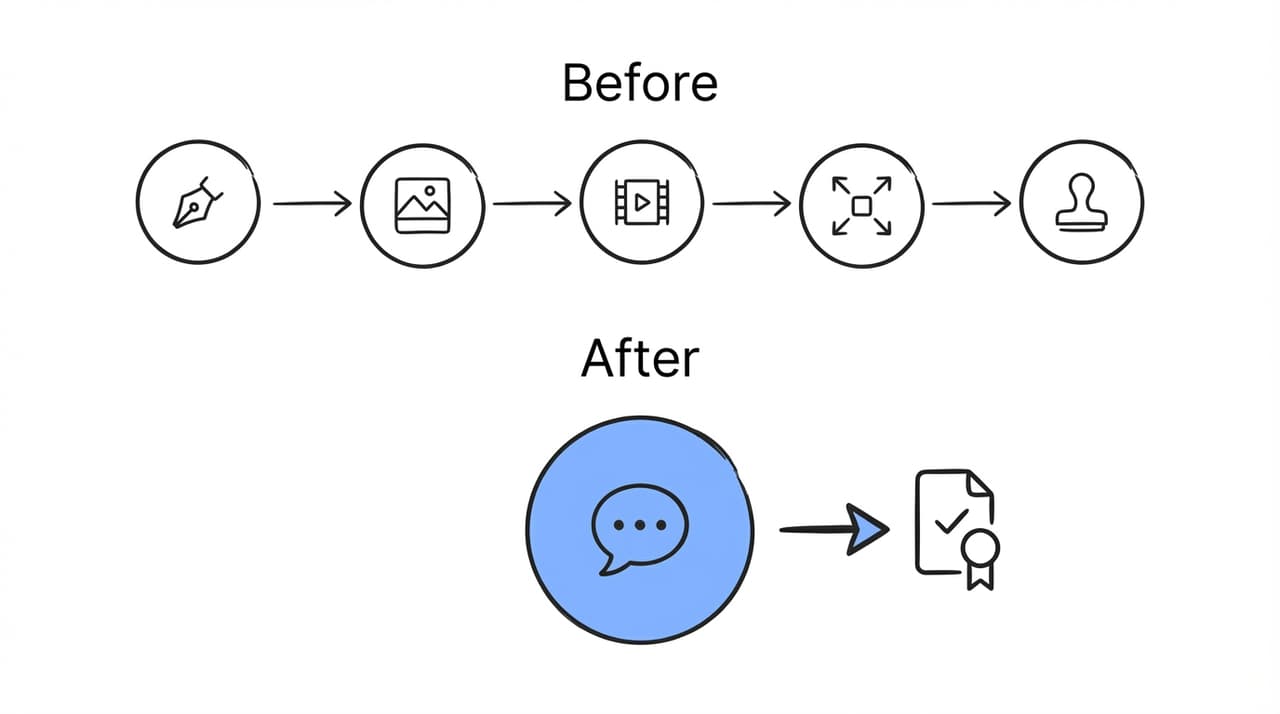
The difference is not just speed. It is continuity. When you say "make the third option feel more premium," the agent knows exactly which output you mean, what you have already approved, and what your brand guidelines require. No re-uploading. No re-explaining. No starting over.
Best Practices for AI Content Creation That Converts
The tools and workflows only matter if the content they produce actually performs. Here are the practices that separate high-performing AI-generated content from generic output.
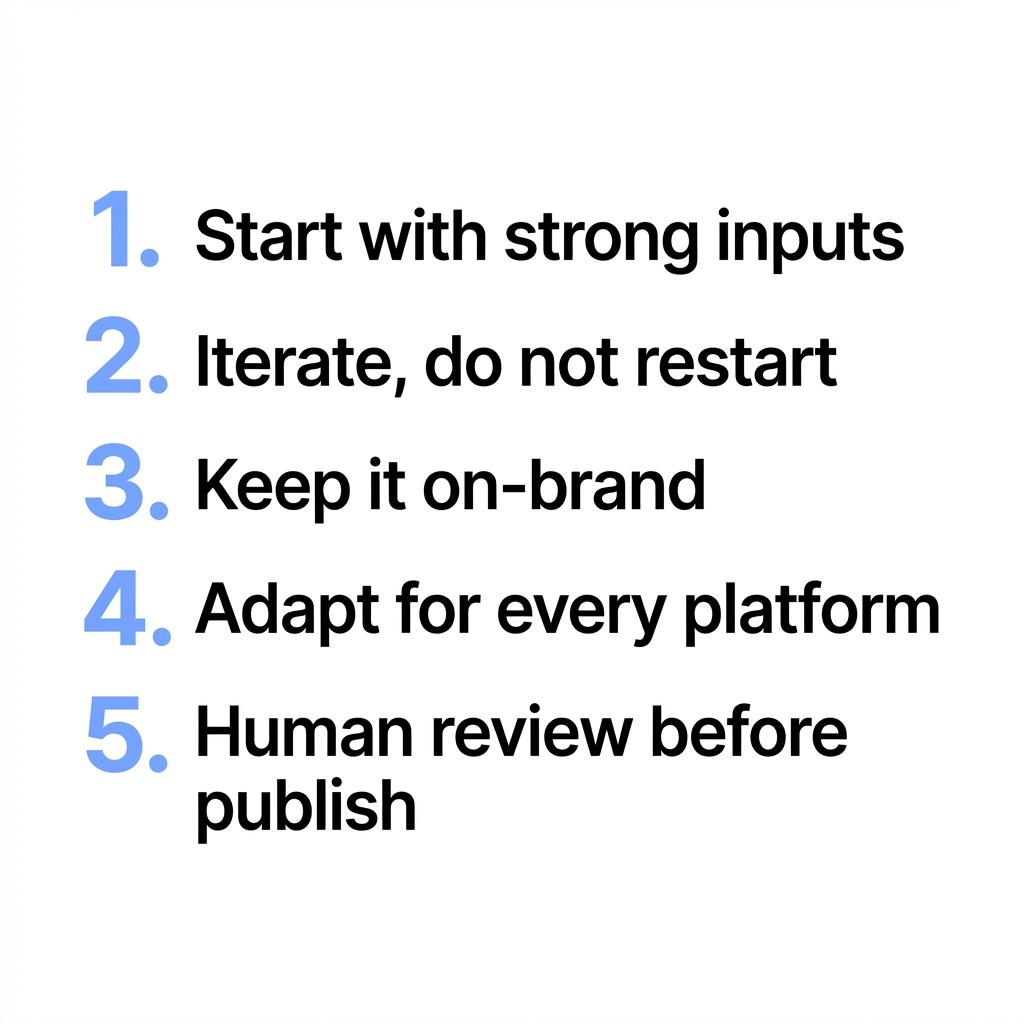
Start with Strong Inputs
The quality of AI-generated content is directly proportional to the quality of the inputs you provide. A vague prompt produces vague output. A reference image, a competitor's ad, a specific mood, or a product URL gives the AI something concrete to build from.
The best results come from combining multiple input types. Upload a product photo, attach your brand kit, reference a style you like, and describe the outcome in plain language. The more context you provide, the fewer rounds of revision you will need.
Iterate Through Conversation, Not Re-prompting
Most people use AI tools in a generate-and-discard pattern. They write a prompt, get a result they do not love, and start over from scratch. This wastes time and context.
The more effective approach is iterative refinement. Start with a first pass, then adjust. "Make it warmer." "Try a different angle." "Use the second layout but with the colours from the first." Each instruction builds on what came before, moving the output closer to what you actually want.
This conversational workflow is what distinguishes an AI agent from a single-purpose generator. Context persistence, the ability to remember and build on prior decisions, turns a chatbot into a creative collaborator.
Always Review and Refine Before Publishing
AI handles the heavy lifting of content production. Humans handle the final direction and quality control. This balance is not going away.
According to HubSpot, 56% of marketers significantly revise AI-generated content or change it completely before publishing (HubSpot, 2025). At the same time, 86% of marketers say AI saves them more than an hour on creative tasks (HubSpot, 2025).
The takeaway: AI does not eliminate the need for human judgment. It eliminates the production bottleneck that kept human judgment waiting. Review every output for brand alignment, visual quality, and messaging accuracy before it goes live.
Key Takeaways
- The generative AI content creation market is projected to grow from USD 14.8 billion in 2024 to USD 80.12 billion by 2030, reflecting massive investment in AI-powered content tools (Grand View Research, 2025).
- Visual content, not text, is where AI content creation delivers the highest measurable ROI. High-quality product images increase ecommerce conversion rates by 33% (BlendNow, 2025).
- Ecommerce businesses benefit the most from AI-powered product photography, seasonal campaign creation, and automatic platform adaptation, capabilities that eliminate the need for expensive studio shoots.
- The shift from juggling multiple disconnected tools to unified AI agent workflows reduces friction and keeps brand identity consistent across every output.
- Human oversight remains essential. The most effective approach is to let AI handle production speed while humans direct creative strategy and final quality review.
Frequently Asked Questions
What is AI content creation?
AI content creation is the use of artificial intelligence to generate, edit, and optimize digital content across formats. This includes text (blog posts, ad copy, product descriptions), images (product photography, social graphics), video (short-form clips, animated ads), and audio (voiceovers, narration). Modern AI content creation platforms handle multiple formats from a single interface, enabling businesses to produce professional-quality content at scale.
How is AI used in ecommerce content creation?
Ecommerce businesses use AI to transform product photos into lifestyle images, generate seasonal promotional content, create platform-specific ad variations, and produce AI image assets for listings on Amazon, Shopify, and social media. AI also enables automatic background replacement, on-model photography with AI-generated models, and image-to-video conversion for product pages.
What types of content can AI generate?
AI can generate blog posts, social media captions, email campaigns, product descriptions, images, product photography, video ads, talking avatar presentations, animated graphics, voiceovers, and full multi-format campaigns. The most advanced platforms produce all of these from a single conversation or workflow, maintaining visual and tonal consistency across every output.
Is AI-generated content good enough for professional use?
Yes, when combined with human review. Retailers using AI-powered visual tools report annual revenue uplifts at a rate of 87% (AutoPhoto, 2025). The key is to treat AI as a production tool, not an autopilot. The most effective workflows involve AI generating initial outputs and humans refining them for brand alignment, accuracy, and quality.
How do AI agents differ from individual AI tools?
Individual AI tools handle single tasks. An image generator creates images. A video tool creates video. A writing assistant creates text. An AI agent orchestrates the full workflow, selecting the right models, breaking complex requests into steps, and maintaining context across an entire conversation. This means you describe the outcome once and the agent handles execution, rather than managing five separate tools yourself.
Can AI create on-brand content consistently?
Yes. Modern AI content creation platforms support Brand Kits that store logos, colour palettes, typography, and visual guidelines. Every asset the AI produces, whether it is an image, video, or graphic, automatically applies these brand elements. This ensures visual consistency across every channel and format, even when producing content at high volume.