Hedra for Developers: Our models, now available through API, SDK, CLI & MCP
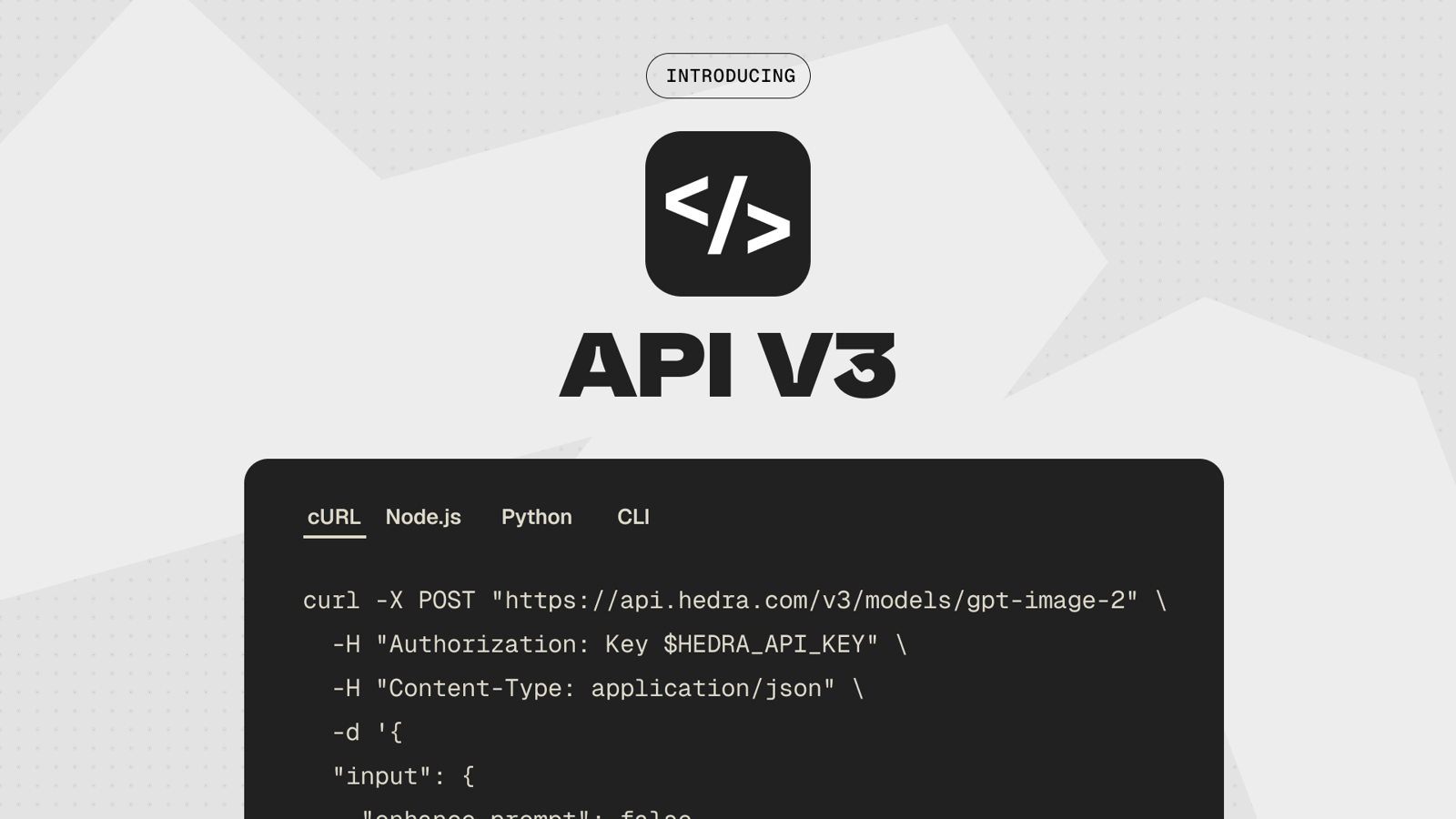
Hedra is a research and infrastructure company in San Francisco building general visual intelligence. From the start, most people have experienced that work through our platform, a place to do your best visual work. Today we're opening the same models up as a developer platform: a unified API, native SDKs, a CLI, and MCP support, so you can build with Hedra directly in your own code and your own agents.
We've quietly run a developer API for a long time, but it sat behind the platform. Two things changed. A large and growing share of generations already come through the API, not only Hedra's own audio, video, and editing models, but the image and video models we route to across the ecosystem. And the way developers build has shifted: more of the work now runs through coding agents and autonomous pipelines rather than hand-written integrations.
That gave us a clear signal. Take the catalog of models people already rely on, put it behind one interface with one bill, and design that interface so both people and agents can use it with very little friction. The result is a single place to reach Hedra's models and partner models together, unified access, unified billing, and a developer experience built for how software gets written today.
One interface, every model
The core idea is composition. In a single API session, an agent can explore ideas with you, generate reference images and start frames with models like Nano Banana and GPT Image, and then call Hedra's own models to produce the final shot — a spokesperson video, say — without leaving the session or stitching together four vendors. You specify the model you want in the call; everything runs through one contract and settles on one bill.
Why build on Hedra
The developer platform is designed to make visual inference faster, more predictable, and easier to operate in production:
- The Hedra inference engine. Loss-free distillation and architectural improvements deliver up to 4× faster generations on Hedra models and are now available for open-source models hosted through the Hedra platform.
- Fully typed SDKs. Native Python and TypeScript SDKs expose model-specific inputs, so developers and coding agents can catch invalid calls before they reach production.
- Live SSE progress for every generation. Stream status and progress updates across image, video, and audio jobs instead of relying on blind polling.
- Dynamic ETAs. Estimated completion times adapt to real observed performance across thousands of generations, giving products and pipelines more predictable delivery windows.
- Flexible pricing, including third-party models. Use the same usage-based billing model across Hedra-hosted and partner models, with options that scale from experimentation to production.
- OTel-native log drains. Send sanitized job logs directly to Datadog and other OpenTelemetry-compatible providers without adding observability work to the generation path.
- Preflight cost estimates. Price a job before it runs, including the inputs, duration, resolution, and other parameters that affect cost.
- Durable, idempotent jobs. Idempotency keys, signed webhooks, and durable asynchronous execution make retries and long-running workflows safer.
- One key, one contract, one bill. Compose leading open and closed models with Hedra's own models without maintaining a separate integration for every provider.
Four surfaces, and when to reach for each
The platform meets you wherever you're working:
- The raw API is the underlying contract. Point an LLM at it or use curl or a standard HTTP library and it can figure out one-off generations on its own. Good for quick calls and experimentation.
- Native SDKs (Python and JavaScript) are what you want when the code lives in a real codebase. Install from your package manager,
import hedra, callhedra.generate, and your integration stays clean. The SDKs are typed, so a coding agent can verify calls against supported parameters at build time instead of discovering mistakes in production. - The CLI is token-efficient and drops cleanly into coding sandboxes like Daytona or e2b, which makes it a fast way to give a coding agent access to Hedra inference.
- MCP is for desktop and chat agents like Claude, Codex, and similar. Because an MCP describes its own tools, an agent knows what to do immediately, without reverse-engineering the API format first.
Rule of thumb: talk to the API directly for quick, agent-driven queries; use the SDKs when you're shipping code; use the CLI or MCP to hand inference to an agent.
Built for agents, not just humans
We designed the API from the ground up to be reasoned about by modern coding models. A few decisions matter more than they might sound:
We handle model selection for you. If you pass a reference image and name a model, we use it as a reference and you don't have to declare the mode a second time. Less hand-holding means fewer places for an agent to get confused, and more trust that what you sent is what we'll use.
Our IDs are prefixed with their type, so an LLM passing them around has little to misread. Small detail, real difference in how reliably agents chain calls together.
And you can estimate before you generate. Send us the job you intend to run and we'll tell you exactly what it will cost before anything executes which is useful for longer, more complex video work where input, output, and resolution all move the price. You decide whether it's worth it, then run it.
Reliability for long-running work
Long-running generations run as durable asynchronous jobs. Configure signed webhooks in the dashboard or per request, and use idempotency keys to retry safely without submitting the same work twice. Underneath, the job system keeps execution dependable even when a downstream provider we don't manage is having a bad day.
Pay for what you use
We're also changing how billing works: away from credits that expire, toward dollars, where you pay for exactly what you generate and top up when you need to. It's a simpler, fairer model and it pairs naturally with cost estimation, so there are no surprises between "preview" and "invoice."
Who this is for
Developers across a wide range. A solo builder using Claude or Codex to stand up a business: a virtual try-on experience for a Shopify store, an automated channel that produces video for a brand. Teams building marketing pipelines that populate visual assets autonomously, or intelligence pipelines that comprehend long-form video. And the enterprises that now trust Hedra to manage their inference workloads outright. If you're building with visual models, this is a full-stack solution for your inference needs.
Where this goes
We've always been focused on one problem: models that can generate and understand the visual world. We think demand for visual inference is going to follow the trajectory of language and expand enormously and that serving it will require inference built for distributed, real-time computation. This launch is our first step toward being the premier provider of visual inference.
The best part is the part we can't predict. Point your agent at the API and build something — we're genuinely curious what you'll make.
Get started with the Hedra developer platform.