AI Generated Advertising: Create and Scale AI Ads in 2026
Key Takeaways
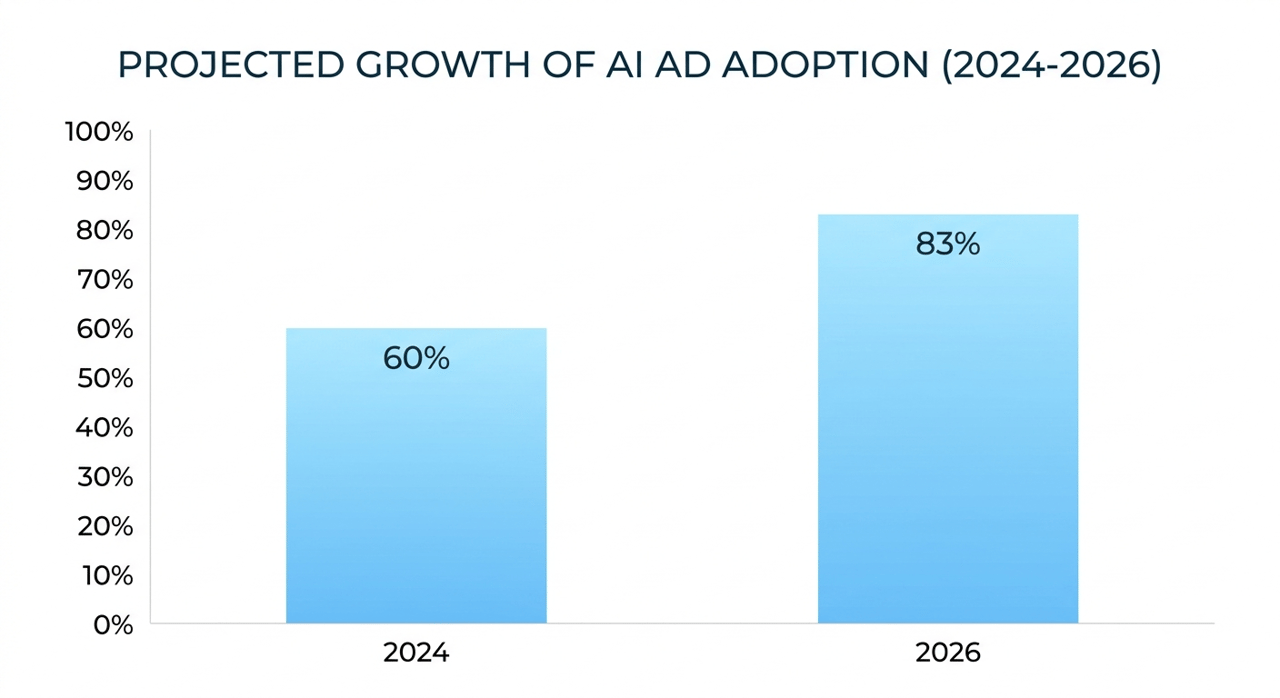
- AI generated advertising has gone mainstream, with 83% of ad executives deploying AI in their creative process as of 2026 (IAB, 2026)
- Traditional ad production costs $10,000 to $50,000 for a 30-second commercial, while AI tools can produce comparable creative at 70-90% lower costs in hours instead of weeks
- The most effective AI generated ads start with strong brand inputs: a quality product image, clear brand guidelines, and defined audience segments
- Consumer perception remains a factor: only 45% of Gen Z and Millennials feel positive about AI ads, making quality control and transparency essential (IAB, 2026)
- Disclosure builds trust, not backlash. 73% of younger consumers say knowing an ad used AI either increases or does not change their purchase likelihood (IAB, 2026)
AI generated advertising has moved from experimental novelty to mainstream production method. In January 2026, the Interactive Advertising Bureau reported that 83% of advertising executives have deployed AI in their creative process, up from 60% just two years earlier (IAB, 2026). The shift is not theoretical. It is happening at scale, across industries, and at every budget level.
Consider the math that convinced the industry. When prediction market Kalshi needed a commercial for the 2025 NBA Finals, traditional agency quotes came in between $250,000 and $500,000. Instead, they hired solo AI filmmaker PJ Accetturo, who produced a broadcast-quality 30-second spot in two days for approximately $2,000 using AI video generation tools (NPR, 2025). The ad generated over 20 million impressions.
That kind of cost reduction is not an outlier. It is the new baseline for generative AI advertising. This guide breaks down what AI generated advertising means in 2026, why the economics have shifted, how to create AI generated ads step by step, and how to avoid the quality and perception traps that trip up unprepared teams.
What AI Generated Advertising Actually Means in 2026
Before exploring how to create AI generated ads, it helps to understand what the term covers today. AI generated advertising refers to ad creative, including images, video, and copy, that is produced using artificial intelligence tools rather than traditional photography, filming, or manual design. The AI interprets a prompt, reference image, or data input and produces finished or near-finished creative assets.
This is not one single technology. It is a spectrum of approaches, often grouped under the broader term generative AI advertising, that marketing teams combine depending on their goals, budget, and quality requirements.
The Three Levels of AI in Ad Creation
Not all AI advertising works the same way. The distinction matters because it determines how much human involvement is needed and where quality risks emerge.
Level | What It Means | Example | Best For |
|---|---|---|---|
Fully AI-generated | AI creates the entire creative from a text prompt or reference image | Product photo generated from a description | High-volume social ads, rapid A/B testing |
AI-assisted | Humans provide direction, AI handles execution | A designer uploads a product photo and the AI generates multiple styled variations | Brand campaigns needing creative control |
AI-optimized | Humans create the ad, AI handles targeting, placement, and bidding | Meta Advantage+ or Google Performance Max campaigns | Performance marketing and retargeting |
Most successful campaigns in 2026 blend the first two levels. A marketing team provides the brand inputs and creative direction. The AI generates the variations at speed.
Which Channels Use AI Generated Ads Most
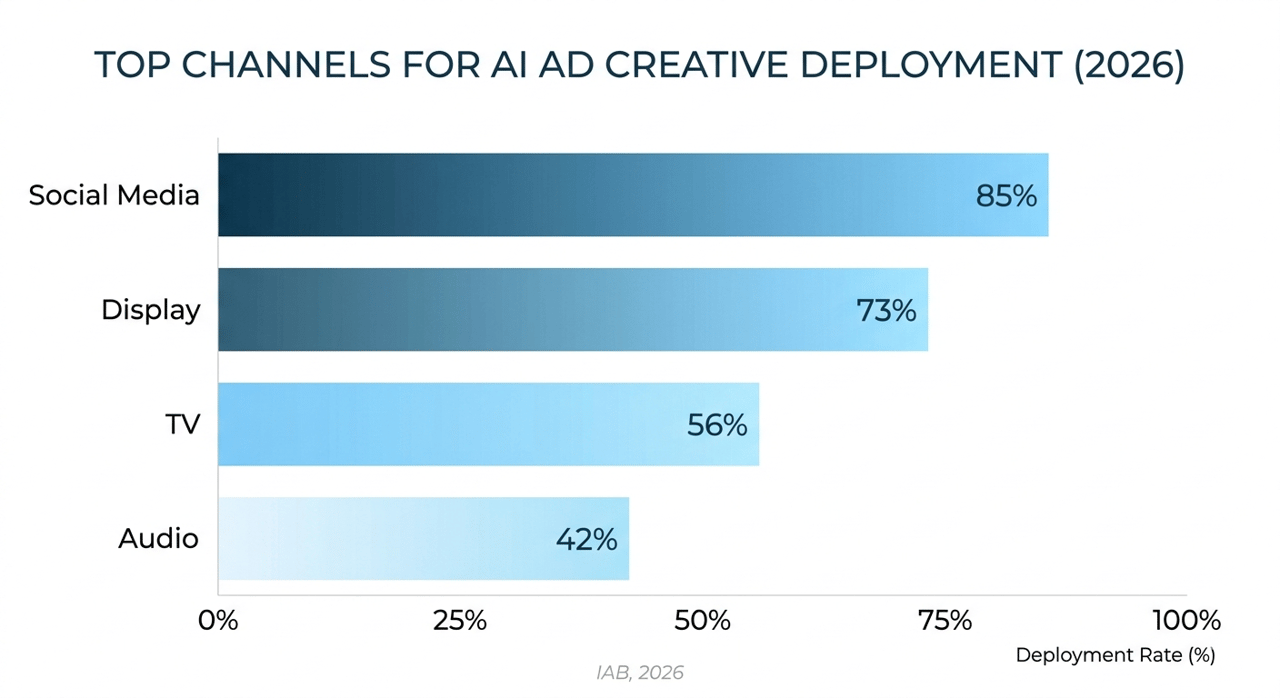
According to the IAB, advertisers deploy AI generated creative most heavily on social media, where 85% of respondents use it. Display advertising follows at 73%, TV at 56%, and audio at 42% (IAB, 2026).
The dominance of social media makes sense. Platforms like Instagram, TikTok, and YouTube require constant creative refreshes. Manually producing enough variations to keep up with platform algorithms is expensive and slow. Generative AI ads close that gap. For teams creating AI video ads, the ability to produce dozens of variations from a single asset is what makes consistent posting sustainable.
Why Marketing Teams Are Switching to AI Ad Creation
The adoption numbers tell one story. The economics tell a more compelling one. Cost efficiency has emerged as the top cited benefit of AI in advertising in 2026, chosen by 64% of industry respondents, up from fifth place in 2024 (IAB, 2026).
The Cost Equation Has Changed
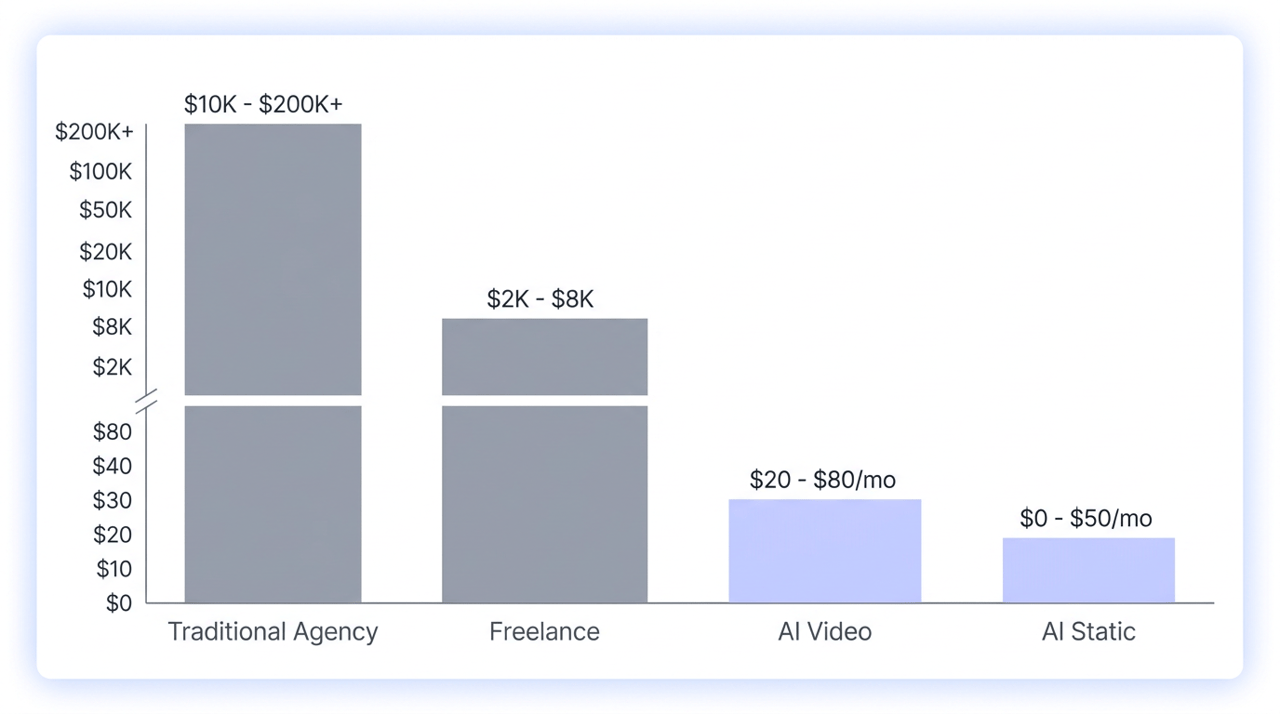
Traditional video ad production remains expensive. A standard 30-second commercial costs between $10,000 and $50,000, with high-end productions reaching $200,000 or more. Even simple corporate videos run $2,000 to $8,000 (Simulmedia, 2025).
AI tools operate at a fraction of these costs. Organizations across industries report producing video content at 70-90% lower costs compared to traditional methods (Magic Hour, 2025). And the Kalshi case study showed that even broadcast-quality results are achievable at roughly 1% of the traditional price point.
Production Type | Cost Range | Timeline | Variations |
|---|---|---|---|
Traditional agency commercial | $10,000 - $200,000+ | 4-8 weeks | 1-3 versions |
Freelance video production | $2,000 - $8,000 | 1-3 weeks | 1-2 versions |
AI-generated video ad | $20 - $80/month (platform subscription) | Hours to days | 20-40+ versions |
AI-generated static ad | $0 - $50/month | Minutes | Unlimited |
Speed Changes the Strategy
When a single ad costs $20,000 and takes six weeks, teams optimize for one "hero" creative. They debate every word, reshoot every angle, and hope it resonates.
When producing variations costs almost nothing and takes hours, the strategy shifts entirely. Instead of guessing which creative will work, teams test 20 or 30 variations and let performance data decide. The brands testing more win more. Volume testing is not a luxury with AI. It is the default approach.
Scale Without Growing the Team
For bootstrapped businesses and solo marketers, the cost of traditional ad production has always been the barrier. Hiring a photographer, a designer, and a video editor for a single campaign is not realistic on a small budget.
AI generated advertising removes that barrier. A small business owner with a product photo and a clear brand identity can now produce professional ad creative without a production team. The result is not just cost savings. It is access to a capability that was previously reserved for brands with agency budgets. An AI image generator can turn a single product shot into polished creative ready for social, display, and web placement. For a broader look at how AI tools are reshaping digital marketing workflows beyond ad creation, the same principles of speed and scale apply across content production.
How to Create AI Generated Advertising Step by Step With Hedra.com
The data makes the case. Now here is how to actually do it. This workflow applies whether you are a solo business owner creating your first AI ad or a marketing team scaling production across channels.
Step 1: Bring Your Inputs Into a Single Conversation
The traditional ad production process starts with a creative brief, a folder of assets, and a kickoff meeting. AI generated advertising starts wherever you are.
With a conversational AI agent like Hedra Agent, you do not need a polished brief or a complete asset library to begin. The Agent meets you at whatever stage of the creative process you are in. Drop in any combination of the following:
- A product photo you took on your phone or downloaded from your supplier
- A URL to your product page, Shopify store, or Alibaba listing. The Agent pulls product details, messaging, and imagery automatically.
- Brand assets such as your logo, brand colours, typography, or existing creative. The Agent applies these consistently across everything it generates in that conversation, so every output stays on-brand without manual checks on each piece.
- A reference or inspiration such as a competitor ad you like, a mood board, or a visual style you want to match. The Agent understands tone, composition, and aesthetic direction and builds from there.
- Just an idea described in plain language: "I want a professional product ad for my new skincare line targeting women aged 25-40"
You can bring one of these or all of them at once. The Agent takes whatever you provide, combines the context, and turns it into a plan, then into finished work. The more brand context you bring in (logo, colours, reference files), the more consistent and on-brand your outputs will be from the first generation.
This is what separates agentic content creation from basic AI image generators. Without brand inputs, AI generates whatever matches the prompt. With them, every variation stays aligned with your identity.
If you are starting from a product photo, these details matter for quality:
- Resolution: At least 1024x1024 pixels. Higher resolution gives the AI more detail for generating variations across different platform sizes.
- Background: Clean, simple backgrounds work best. A white or neutral background lets the AI replace or modify the setting without visual artifacts.
- Lighting: Even, natural lighting produces the most versatile results. Harsh shadows carry over into generated variations.
- Subject clarity: The product should be the clear focal point, centred in the frame, with no competing visual elements.
If your source image does not meet these standards, the Hedra AI image generator can produce one from a text description or reference URL, giving you a clean starting point for ad variations.
Step 2: Describe What You Want and Let the Agent Execute
This is where the workflow diverges from traditional AI tools that require you to write individual prompts for each output. With a conversational agent, you describe the outcome and the Agent breaks the work into steps, picks the right approach for each, and executes.
For example, you might say: "Turn this product photo into a set of social ads with professional lighting, seasonal holiday backgrounds, and my brand colors." The Agent adjusts lighting and composition, generates multiple angles, applies your brand kit, and outputs platform-ready layouts in one continuous flow.
From a single input, generate variations across three dimensions:
Platform format. Square (1:1) for Instagram feed, vertical (9:16) for TikTok, Reels, and Stories, landscape (16:9) for YouTube pre-roll and website banners. The Agent handles platform adaptation automatically, maintaining visual consistency without manual rework for each size.
Audience segment. Different messaging for different customer groups. A skincare brand might generate one variation emphasizing ingredients for a health-conscious audience and another emphasizing luxury packaging for a gifting audience. A restaurant might generate a warm, inviting version for local families and a high-energy version for weekend nightlife audiences. The product is the same. The framing changes.
Content type. This is where generative AI advertising unlocks the most variety from a single input:
- Static images for social feeds and website banners
- Short-form video (5-15 seconds) for social platforms. Learn more about how to make AI video for ad creative.
- Image-to-video conversion for turning a product photo into an animated ad with motion and environment. The image-to-video guide covers specific techniques.
- Text-to-video generation for creating a complete video ad from a written prompt
- Seasonal and localized variations such as holiday-themed backgrounds, market-specific colour palettes, or language-adapted copy
A practical starting point: generate 3 static image variations and 2 short-form video variations from your best product image. Test all five on a single platform before expanding to additional channels.
Step 3: Refine Through Conversation, Not Re-Prompting
This is the capability that makes conversational AI agents fundamentally different from standalone generators. The Agent remembers every instruction, decision, and preference within a thread. When you want revisions, you are refining, not starting over.
You might say: "I like the third variation, but make it feel more premium and change the background to something warmer." The Agent knows exactly what you mean. It builds on the previous output instead of regenerating from scratch. No re-uploading, no re-prompting, no losing the work that came before.
This matters for ad production because creative direction is iterative by nature. The first output is rarely the final one. The question is whether each iteration costs you 30 seconds of conversation or 30 minutes of re-prompting and re-uploading across separate tools.
Step 4: Test, Measure, and Scale What Works
Before scaling anything, test it. Launch 3-5 of your generated variations on a single platform with equal budget. After 7 days, review click-through rate, engagement, and cost per result to identify which creative direction resonates.
The advantage of AI generated advertising is that iteration costs nearly nothing. If a headline underperforms, regenerate it in the same conversation. If a visual style resonates, tell the Agent to produce 10 more versions in that direction. Traditional production makes each iteration expensive. AI makes it trivial.
Once you identify a winning variation, scale it across channels, languages, and seasonal contexts. The same product image that performed well on Instagram can be adapted for a holiday-themed version, localized for a different market, or extended into a video format.
This is where the economics compound. The initial creative investment (one product photo, one set of brand inputs, one conversation thread) generates an expanding library of on-brand ad creative over time. And because the Agent maintains context, returning to a previous project months later means picking up where you left off.
Avoiding the Quality Traps of AI Generated Ads
Speed and cost savings mean nothing if the output damages your brand. AI generated advertising introduces specific quality risks that traditional production does not, and understanding them is the difference between results and backlash.
The Uncanny Valley Problem
Research from Kantar found that AI generated ads evoke stronger emotional reactions than non-AI ads, but net positivity is lower (Kantar, 2025). The reason is the "uncanny valley" effect: when AI-generated visuals of people look almost human but not quite right, viewers feel discomfort rather than connection.
This is supported by broader consumer data. YouGov research across 17 markets found that roughly half of consumers (47-51%) feel uncomfortable with AI-generated brand ambassadors or product images that depict people in advertising (YouGov, 2025).
The practical takeaway: product photography, design-focused visuals, and brand graphics are safer starting points for most businesses than synthetic human faces. If your ad is about a product, let the product be the star. If you need human characters, invest in higher-quality generation and rigorous review.
Why Brand Consistency Matters More with AI
Without guardrails, AI generates whatever matches the prompt. That output may be visually impressive but completely off-brand. Inconsistent colours, mismatched typography, or a visual tone that clashes with your existing marketing can confuse customers and dilute brand recognition.
This is why features like brand kits and reference file uploads matter. When the AI understands your brand identity from the start, every generated ad variation stays aligned without manual quality checks on each piece. Teams that skip this step end up spending more time fixing outputs than they saved by using AI in the first place.
Human Review Is Not Optional
AI handles execution. Humans handle judgment. Every AI generated ad should go through a review before launch. Check for visual artifacts, verify that text overlays render correctly, and confirm that the creative aligns with your brand tone.
This is especially important for regulated industries like healthcare, finance, and alcohol, where ad content must meet specific compliance standards. AI does not understand regulatory context. A human reviewer does.
Real Brands Using AI Generated Advertising in 2026
These are not hypothetical scenarios. Brands are already running AI generated ad campaigns at production scale.
Kalshi produced a broadcast-quality NBA Finals commercial using Google Veo 3 in two days for approximately $2,000. The traditional agency equivalent would have cost $250,000 or more. The ad generated over 20 million impressions and over 3 million views on X alone (NPR, 2025).
Coca-Cola used AI for its holiday advertising campaign for the second consecutive year, attracting mainstream attention alongside AI-generated video executions from Volvo and other global brands (IAB, 2026). The Coca-Cola campaign also demonstrated the quality risk: public backlash over perceived lack of authenticity shows that even well-resourced brands need to manage AI creative carefully.
Mondelez committed $40 million to an AI creative platform built with Publicis Groupe and Accenture, targeting a 30-50% reduction in marketing content production costs. AI-generated content for Chips Ahoy and Milka is already running on social media (Virvid, 2026).
These examples share a common thread. None of them replaced their creative teams. They all used generative AI advertising to accelerate production, reduce costs, and increase the volume of variations they could test.
How to Get Started with AI Generated Advertising Today
You do not need a $40 million budget to start. Here is a practical starting point for any marketing team or small business owner.
- Choose one product or service to test. Do not try to overhaul your entire ad strategy at once. Pick a single product with a strong visual asset.
- Gather your brand assets. Logo file, brand colours (hex codes), any existing ad creative that represents your visual identity. Upload these to your AI platform as a brand kit or reference files.
- Start with static image ads before video. Image generation is faster, cheaper, and easier to review. Once you have a workflow that produces consistent results, expand to AI video ads and UGC-style video.
- Test 3-5 variations on one platform. Run them simultaneously with the same budget. Let performance data tell you which creative direction works.
- Measure results after 7 days and iterate. Look at CTR, engagement rate, and cost per result. Generate more variations in the direction of your top performer.
The brands getting the most from AI generated advertising are not the ones with the biggest budgets. They are the ones who build a repeatable workflow, maintain brand consistency, and let data guide their creative decisions.
Frequently Asked Questions
What is AI generated advertising?
AI generated advertising refers to ad creative produced using artificial intelligence tools rather than traditional photography, filming, or manual design. This includes AI-generated images, videos, ad copy, and interactive media. In 2026, 83% of advertising executives report using AI in their creative process (IAB, 2026).
How much does it cost to create AI generated ads?
AI ad creation platforms typically cost between $20 and $80 per month for subscription access. Compare this to traditional production, where a 30-second commercial costs $10,000 to $50,000 and simple corporate videos run $2,000 to $8,000 (Simulmedia, 2025). The cost reduction for high-volume ad production is typically 70-90%.
Are AI generated ads effective?
Yes, when guided by clear brand inputs and quality oversight. The IAB reports that 86% of video ad buyers are using or planning to use generative AI for creative production (IAB, 2025). Generative AI ads are particularly effective for high-volume testing scenarios where teams need dozens of creative variations quickly. Effectiveness depends on input quality, brand consistency, and systematic testing, not on AI alone.
Do I need to disclose that my ads were made with AI?
Disclosure requirements are evolving. The IAB launched its first AI Transparency and Disclosure Framework in January 2026, recommending risk-based disclosure for synthetic humans, AI-generated voices, and chatbots (IAB, 2026). Research shows that 73% of younger consumers say disclosure would not negatively affect their purchase likelihood, making transparency a trust builder.
Can small businesses use AI generated advertising?
Absolutely. AI generated advertising is particularly valuable for small businesses and solo marketers who lack the budget for traditional production agencies. A single product photo and a set of brand inputs can generate dozens of professional ad variations. Platforms with AI video ad capabilities make professional video production accessible without specialized equipment or expertise.
What types of AI generated ads perform well in 2026?
Product-focused image ads, short-form social video, and localized ad variations are the strongest performers. Social media is the leading channel for AI generated ads, with 85% of advertisers deploying AI creative there (IAB, 2026). Product photography and design-driven visuals tend to outperform AI-generated human characters, which can trigger the uncanny valley effect.
How do I keep AI generated ads on brand?
Upload your brand assets (logo, colours, typography, existing creative) to your AI platform before generating any ad creative. Use platforms that support brand kits and reference file uploads so the AI learns your visual identity. Then review every output before launch. Brand consistency is the most common failure point in AI ad production, and it is the easiest to prevent with proper setup.
What should I look for in an AI ad creation platform?
Prioritize platforms that offer brand kit uploads, multiple AI model options, and the ability to generate both static images and video from the same workspace. The ability to go from a single reference image to multiple ad formats without switching tools saves significant time. Look for platforms that let the AI learn from your existing assets rather than starting from scratch with every prompt. Integration with your existing workflow, whether through exports, direct publishing, or API access, also matters for long-term scalability.