AI Tool for Digital Marketing: The 2026 Complete Guide
The right AI tool for digital marketing is no longer a competitive advantage. It is a baseline requirement. With the global AI marketing market valued at $47.3 billion in 2025 and projected to exceed $107.5 billion by 2028 (Statista, 2025), the shift is already underway.
Digital marketers who have not yet integrated AI into their workflows are not just moving slower. They are working with a smaller toolkit than their competitors.
This guide breaks down every major category of AI marketing tools, what each one does well, and how to build a stack that works together from concept to published campaign.
Why AI Has Become the Standard Tool for Digital Marketing Teams
Five years ago, AI tools for marketing were niche software used by enterprise teams with large budgets. Today, 88% of marketers use AI tools daily (Social Media Examiner, 2025), and 84% report increasing their usage over the past year.
The numbers make the case plainly:
- Productivity gains are measurable. 83% of marketers report increased productivity since adopting AI tools, with 50% saving one to five hours per week on routine tasks (Social Media Examiner, 2025).
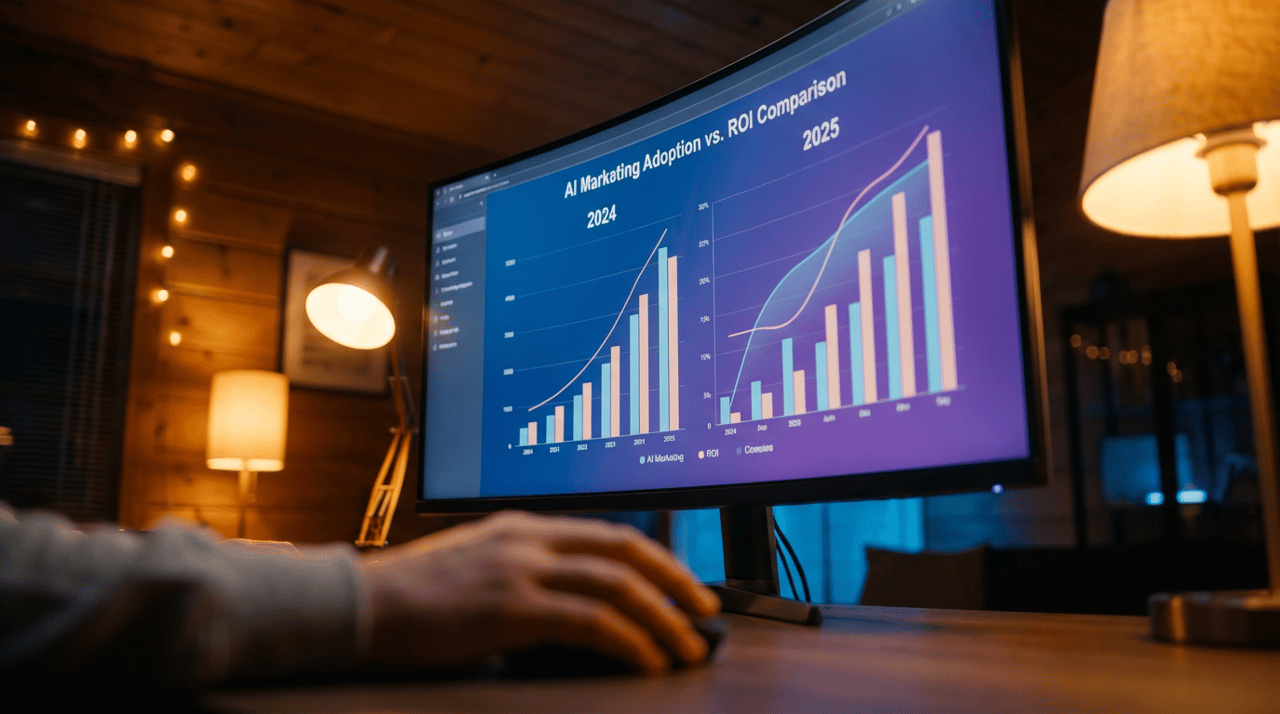
- Campaign performance improves. Organizations using AI in marketing see 20-30% higher campaign ROI compared to those relying on traditional methods (McKinsey, 2024).
- Content creation accelerates. 90% of marketers now use AI for idea generation, 89% for draft creation, and 86% for headline writing (Social Media Examiner, 2025).
- Daily adoption has surged. 60% of marketers use AI tools daily in 2025, up from 37% in 2024, with 84% reporting increased usage over the past year (Social Media Examiner, 2025).
The reason behind these gains is not automation for automation's sake. It is the ability to move from idea to finished asset in hours rather than days, test more variations, reach more audiences, and personalise at a scale that was previously out of reach for most teams.
The Core Categories of AI Tools for Digital Marketing
Not all AI marketing tools do the same thing. The most effective marketing stacks in 2026 layer several categories together. Here is a breakdown of each category and what it delivers.
Category | Primary Function | Best For | Typical Output |
|---|---|---|---|
AI Video Generation | Produce video from images, text, or audio | Product ads, UGC content, training videos | Finished video clips and campaigns |
AI Content Writing | Draft, repurpose, and optimize text | Blog posts, emails, ad copy, social captions | Written content across channels |
AI Image Creation | Generate brand-consistent visuals | Ad creatives, product visuals, social imagery | Static images and design assets |
AI Analytics and Personalization | Segment audiences and personalize at scale | Email personalization, ad targeting, journey mapping | Data-driven campaign optimization |
AI Workflow Automation | Connect tools and automate operations | Lead routing, content repurposing, scheduling | Cross-platform orchestration |
1. AI Video Generation Tools
Video is the highest-engagement format across every major digital channel. Yet for most marketing teams, producing video at scale has historically been the most resource-intensive task in the content workflow.
AI video generation tools change that equation. A product marketer can go from a feature brief to a polished video in an afternoon. A social media manager can produce weekly video content without booking a studio.
Key use cases include:
- Product advertisements for paid social and e-commerce
- UGC-style content that drives authentic engagement on TikTok and Instagram
- Learning and development videos for onboarding and training
- Personalized video outreach for sales and account-based marketing
Hedra Studio is a visual creation platform built for exactly this type of output. With world-leading AI models including Character-3, the first omnimodal foundation model in production, creators can produce character-driven video with synchronized voice, expression, and motion directly from a still image. You can explore what this looks like in practice through the image-to-video guide on the Hedra blog.
The result is a workflow that fits inside a single platform: generate an image, animate a character, add voice, export. What will you create?
2. AI Content Writing Tools
Written content remains the backbone of SEO, email marketing, and social media. AI writing tools help teams produce drafts, repurpose existing content across formats, and optimize copy for specific audiences and channels.
The most common use cases in 2026 include:
- Blog and article drafting to accelerate SEO content production
- Email subject lines and body copy for A/B testing at scale
- Ad copy variations for paid search and social
- Social media captions tailored to each platform's format and tone
90% of marketers now use AI for text-based tasks, with the top applications being idea generation (90%), draft creation (89%), and headline writing (86%) (Social Media Examiner, 2025).
The important caveat is quality control. AI drafts require human editing, particularly for accuracy, brand voice, and factual claims. The best-performing teams use AI as a starting engine, not a final publisher.
3. AI Image and Visual Creation Tools
Marketing teams have always needed a high volume of visual assets, whether for ads, organic social, blog thumbnails, or email headers. AI image generation tools now make it possible to produce brand-consistent visuals without a designer on standby.
Key applications for marketing include:
- Ad creative variations for paid campaigns requiring multiple sizes and formats
- Product visualizations without the need for a photo shoot
- Blog and social imagery aligned with brand guidelines
- Concept exploration before committing to a full production process
When images and video generation sit inside the same platform, the creative workflow becomes significantly more efficient. Assets can move from a generated image directly into a video without switching tools.
4. AI Analytics and Personalization Tools
Data has always been central to digital marketing. AI tools for analytics and Personalization take this further by identifying patterns across large datasets and acting on them in real time, which was not possible with manual analysis.
Applications include:
- Predictive audience segmentation that identifies high-value prospects based on behaviour signals
- Dynamic email Personalization that adapts content based on subscriber data, improving engagement rates by 15 to 25% across campaigns (LoopexDigital, 2025)
- Real-time ad optimisation that redistributes budget toward better-performing creatives
- Customer journey mapping that surfaces where users drop off and what messaging brings them back
The practical benefit for marketing teams is that personalization at scale stops being a manual task and becomes a systematic output of the workflow itself. Companies that excel at personalization drive 40% more revenue from those activities than average performers (McKinsey, 2024).
The practical benefit for marketing teams is that personalization at scale stops being a manual task and becomes a systematic output of the workflow itself.
5. AI Automation and Workflow Tools
Beyond individual content types, AI automation platforms connect the different tools in a marketing stack and handle the operational overhead between them.
Tasks that these platforms handle include:
- Routing new leads from a landing page into a CRM and triggering a follow-up sequence
- Monitoring competitor activity and generating a weekly intelligence summary
- Repurposing a long-form article into social media posts across multiple formats
- Scheduling and publishing content across channels based on optimal timing data
60% of marketers now use AI tools daily for these workflow functions, up from 37% in 2024 (Social Media Examiner, 2025). The time recovered from these automated processes is typically redirected to strategy, creative direction, and brand building.
How to Choose the Right AI Tool for Digital Marketing
The number of AI tools available in 2026 is overwhelming. A structured approach to selection saves time and reduces the likelihood of adopting tools that do not fit together.
Start with your production bottleneck. Where does your marketing workflow slow down most? If it is content volume, start with AI writing or video tools. If it is campaign performance, start with analytics and personalization. Solving the highest-friction point first produces measurable ROI faster.
Consider platform consolidation. Using six single-purpose tools creates integration complexity and switching costs. Platforms that offer multiple capabilities, such as image generation, video creation, and audio in a single workspace, reduce this friction.
Match tools to your team's skill level. Not every AI tool requires technical expertise. The best platforms are designed so that a content creator or marketing manager can go from concept to production without engineering support. Beautifully simple software that slots into your workflow is more useful than technically impressive software that requires a developer to operate.
Audit for channel fit. The channels your audience uses should determine the tools you prioritise. Video-first channels like TikTok, Instagram Reels, and YouTube Shorts require different tools than email-first or SEO-first strategies.
AI Video: The Most Underused Tool in Digital Marketing
Video is the format with the highest organic reach, the best completion rates, and the strongest recall in paid advertising. Yet in most marketing stacks, it is also the most underproduced format because traditional production is expensive and slow.
69% of marketers report wanting to develop AI video creation skills, making it the second most sought-after AI capability after workflow automation (Social Media Examiner, 2025). The interest is there. The barrier has been access to tools that make video production fast enough to fit inside a normal content cycle.
AI video generation tools have removed that barrier.
A marketing team can now produce a product ad, an educational walkthrough, or a social media character video without a film crew, a studio booking, or a post-production queue. The full process, from uploaded image to exported video, can happen in a single session.
Hedra's AI audio-driven facial animation guide and character creation guide walk through practical workflows for building this type of content. For teams just getting started, the Hedra creator plan provides the tools needed to move from experimentation to regular production at a predictable cost.
For enterprise marketing teams that need to produce video at scale across multiple products, markets, and languages, the Hedra enterprise offering supports that level of output. Hedra's enterprise clients include Fortune 500 companies, and the platform is built to maintain visual and brand consistency across high-volume campaigns.

Frequently Asked Questions
What is an AI tool for digital marketing?
An AI tool for digital marketing is a software platform that uses machine learning or generative AI to automate, accelerate, or improve a marketing task. These tools cover a wide range of functions including content creation, video generation, image production, audience segmentation, and campaign analytics. Most AI marketing tools are designed to reduce the time required for repetitive creative and analytical work so that marketers can focus on strategy and audience connection.
Which types of AI tools are most useful for digital marketers?
The most useful AI tools depend on where your workflow slows down. For content teams, AI writing and video generation tools deliver the highest immediate impact. For performance marketing teams, AI analytics and personalization tools improve campaign efficiency. Platforms that combine multiple capabilities, such as image generation, video creation, and audio processing in one workspace, are particularly effective for small to mid-size marketing teams that cannot afford to manage a large number of separate tools.
Can AI tools for digital marketing improve ROI?
Yes. Organizations using AI in marketing see 20-30% higher campaign ROI compared to those relying on traditional methods (McKinsey, 2024). These gains come from better audience targeting, faster content production cycles, and the ability to test more creative variations within the same budget and timeline.
Is AI video worth investing in for digital marketing?
Video is the highest-engagement content format on virtually every digital channel. AI video generation tools make it possible to produce professional-quality video without a film crew or production budget. For marketing teams that currently produce little or no video due to resource constraints, adopting an AI video tool represents one of the highest-ROI investments available. You can explore what AI video looks like in practice with the Hedra image-to-video guide.
How do I start using AI tools for digital marketing?
Start by identifying the task in your marketing workflow that takes the most time relative to its output. That is your highest-value point of entry for AI. From there, choose a platform that addresses that specific task without requiring technical setup. Most leading AI marketing platforms offer a free tier that lets you test the workflow before committing to a paid plan. Visit Hedra's pricing page to explore what is included at each level, including the base free tier.
Do AI tools replace human marketers?
No. The most effective AI marketing implementations use AI to handle high-volume, repetitive, or technically complex tasks while keeping human marketers in charge of strategy, brand voice, audience understanding, and final quality control. Only 36% of marketers worry about AI displacing their roles, reflecting a widespread understanding that AI is a production tool, not a strategic replacement (Social Media Examiner, 2025). The best results come from treating AI as a creative and analytical partner that amplifies what a skilled marketer can accomplish.
Key Takeaways
- The global AI marketing market reached $47.3 billion in 2025 and is projected to exceed $107.5 billion by 2028, growing at 36.6% annually (Statista, 2025).
- 88% of marketers use AI in their day-to-day roles, with 60% using AI tools daily and 83% reporting increased productivity (SurveyMonkey, 2025; Social Media Examiner, 2025).
- The five core categories of AI tools for digital marketing are video generation, content writing, image creation, analytics and personalization, and workflow automation.
- Organizations using AI in marketing see 20-30% higher campaign ROI compared to traditional methods (McKinsey, 2024).
- 69% of marketers want to build AI video creation skills, making it the highest-growth area in the AI marketing toolkit (Social Media Examiner, 2025).
- Platform consolidation reduces workflow friction. Tools that handle image, video, audio, and export within a single workspace outperform fragmented single-purpose stacks.
What will you create?
Explore Hedra Studio and go from concept to production in minutes. Start free at hedra.com
Related Reading: